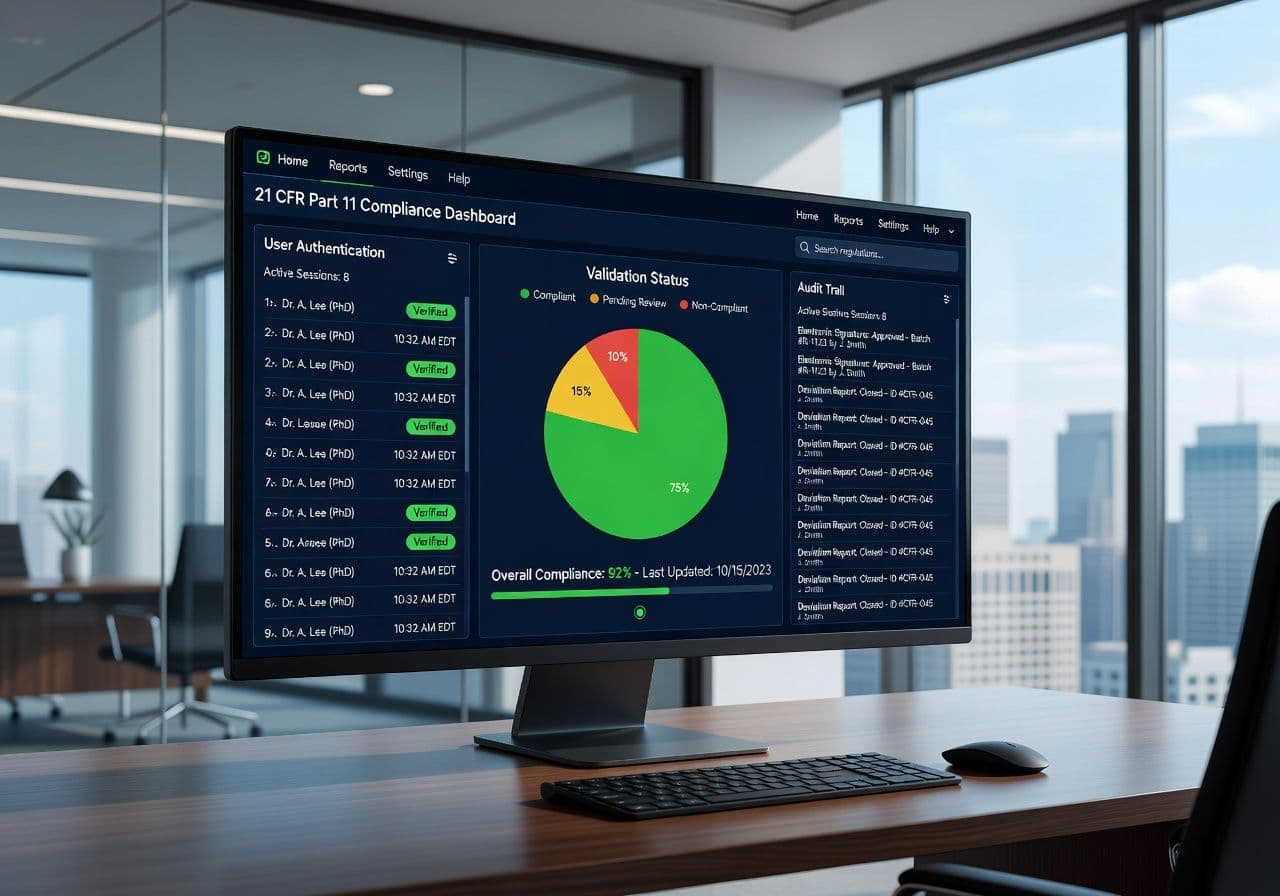
Part 11 and Heaven: A Guide to FDA Compliance | Valkit.ai
Part 11 and Heaven: A Guide to FDA Compliance
Master 21 CFR part 11 compliance: Guide to electronic records, signatures, audit trails, validation & FDA enforcement for pharma & biotech.
Steve Ferrell·
What Is 21 CFR Part 11 Compliance — and Why It Matters
21 CFR part 11 compliance means meeting the FDA's requirements for electronic records and electronic signatures (ERES) so they are considered trustworthy, reliable, and legally equivalent to paper records and handwritten signatures.
Here's the short version of what it requires:
Requirement What It Means System Validation Prove your system works accurately and consistently Audit Trails Automatically track every change — who, what, when, and why Access Controls Limit system access to authorized users only Electronic Signatures Signatures must be unique, authenticated, and linked to the record Record Retention Store records securely and make them retrievable for inspections
If your organization creates, modifies, stores, or submits FDA-required records in electronic form, Part 11 applies to you.
Getting it wrong isn't just a paperwork problem. Non-compliance can trigger production shutdowns, product recalls, and costly remediation cycles — outcomes no validation manager wants to explain to leadership.
Part 11 has been in force since August 1997, but its interpretation has shifted significantly over the decades. A major FDA guidance document issued in 2003 narrowed its scope and introduced the concept of enforcement discretion — meaning the FDA acknowledged that some requirements were overly burdensome and committed to a more risk-based approach. That nuance is where many organizations still get tripped up.
I'm Stephen Ferrell, Chief Product Officer at Valkit.ai, and over more than two decades working in pharmaceutical quality systems and computerized system validation, I've guided hundreds of organizations through the complexities of 21 CFR part 11 compliance — from initial assessments to audit-ready implementations. In this guide, I'll walk you through exactly what the regulation requires, where the real compliance risks hide, and how modern tools can help you get there faster and more efficiently.
[@portabletext/react] Unknown block type "image", specify a component for it in the `components.types` prop
Understanding the Scope of 21 CFR Part 11 Compliance
When we talk about the scope of 21 CFR part 11 compliance, we are looking at the legal boundaries of the digital world in the eyes of the FDA. According to , the regulation applies to records in electronic form that are created, modified, maintained, archived, retrieved, or transmitted under any FDA record requirements.
[@portabletext/react] Unknown block type "image", specify a component for it in the `components.types` prop
It is important to note that Part 11 does not apply to paper records that are transmitted via fax or scanned solely for convenience. However, if you are using an electronic system to perform regulated activities—such as signing off on a batch record or approving a clinical trial protocol—you are firmly in Part 11 territory. The goal is to ensure that these digital "papers" are just as reliable as their physical ancestors. During agency inspections, the FDA expects these systems to be readily available for review, meaning you can't just hide your servers and hope for the best.
Who Must Comply with 21 CFR Part 11?
In short: almost everyone in the life sciences ecosystem. This includes:
Pharmaceutical and Biotech companies managing drug development and manufacturing.
Medical Device manufacturers tracking design history files and quality audits.
Contract Research Organizations (CROs) and Contract Manufacturing Organizations (CMOs) handling data on behalf of sponsors.
Clinical Laboratories and food/cosmetic companies that fall under specific FDA mandates.
At Valkit.ai, we see many of these organizations struggling with the transition from manual processes to digital ones. Moving toward Digitizing CQ with ValKit AI is a common path for those looking to maintain compliance without the administrative "death by a thousand papercuts."
The Role of Predicate Rules in Part 11 Compliance
You cannot understand Part 11 without understanding "predicate rules." These are the underlying requirements found in the Federal Food, Drug, and Cosmetic Act (FD&C Act), the Public Health Service Act (PHS Act), or other FDA regulations.
Think of it this way: Part 11 doesn't tell you which records to keep; the predicate rules do (like CGMP or GLP). Part 11 only tells you how to keep them if you choose to go digital. If a predicate rule says you must keep a signature for a laboratory test, Part 11 kicks in to define what that signature must look like in an electronic system. Moving to Digital Validation Beyond Paper-on-Glass ensures that you aren't just taking a picture of a paper form, but actually meeting the data integrity standards these predicate rules demand.
Technical Requirements for Electronic Records and Systems
To achieve 21 CFR part 11 compliance, your systems must meet specific technical and procedural controls. These controls differ slightly depending on whether you are running a "closed" or "open" system.
Feature Closed System (§ 11.10) Open System (§ 11.30) Definition Access is controlled by the persons responsible for the content of electronic records. Access is NOT controlled by the persons responsible for the content. Security Standard access controls and authority checks. Additional measures like digital encryption and digital signature standards. Validation Required to ensure accuracy and reliability. Required, often with higher scrutiny on data transmission.
Essential Components of a Compliant Audit Trail
The audit trail is the "black box" of your compliance system. It must be secure, computer-generated, and time-stamped. According to the regulations, an audit trail must record the date and time of operator entries and actions that create, modify, or delete electronic records.
Crucially, the audit trail must be "non-obscuring." This means if you change a value from 10 to 20, the audit trail must show both the original 10 and the new 20, along with who made the change and why. These records must be retained for at least as long as the subject records themselves. We've seen that Delivering CSA with ValKit AI helps automate these logs, ensuring that "who did what" is never a mystery during an inspection.
System Validation and Risk-Based Approaches
Validation is the process of proving that your software does what it’s supposed to do, consistently. This typically involves the classic IQ/OQ/PQ (Installation, Operational, and Performance Qualification) framework.
The FDA Guidance for Industry (2003) clarified that validation should be based on a "justified and documented risk assessment." You don't need to validate your word processor if you're just writing a memo, but you absolutely must validate the system that calculates drug dosages. Many companies still rely on outdated tools, but The Hidden Costs of Legacy Digital Validation Tools often include slower release cycles and higher failure rates during audits.
Electronic Signatures: Subpart C Controls
Subpart C of Part 11 is all about making sure an electronic signature is as binding as a pen-and-ink one. To do this, the FDA requires a specific "manifestation" of the signature.
When you sign a document electronically, the system must clearly display:
The printed name of the signer.
The date and time the signature was executed.
The "meaning" or reason for the signature (e.g., review, approval, or authorship).
These requirements were solidified in 62 FR 13464, and they remain a cornerstone of modern compliance.
Executing 21 CFR Part 11 Compliance for Signatures
For non-biometric signatures (like a username and password), you must use at least two distinct identification components.
Initial Signing: You must enter both components (e.g., User ID AND Password).
Continuous Access: If you are in a single, continuous session, subsequent signings might only require one component (like just the password), provided the system maintains a secure link to your identity.
Non-repudiation: The system must be designed so that unauthorized use is nearly impossible and would require the collaboration of two or more individuals to "fake" a signature.
FDA Enforcement Discretion and Legacy Systems
In 2003, the FDA realized that the industry was struggling with the sheer cost of upgrading every single computer system to meet Part 11. They issued a guidance document narrowing the scope and exercising "enforcement discretion."
This doesn't mean Part 11 is optional. It means the FDA will focus its inspections on things that directly affect product quality and safety. For "legacy systems"—those operational before August 20, 1997—the FDA generally won't penalize you for Part 11 gaps if the system meets predicate rules and you have documented evidence that it is "fit for use."
Managing Legacy Systems and Record Retrieval
If you are still running a legacy system, you must ensure that records can be retrieved in a human-readable form. If an inspector asks for a copy, you should be able to provide it in a common portable format (like a PDF or XML).
We often recommend migration strategies that move data out of these "dinosaurs" and into modern, validated platforms. Holding onto old systems is risky, as the "fitness for use" documentation becomes harder to maintain as the hardware ages.
Frequently Asked Questions about Part 11
Does Part 11 apply to cloud-based or SaaS systems?
Yes, absolutely. Whether the software is on your server or in the cloud, the requirements for 21 CFR part 11 compliance remain the same. The challenge with SaaS is that you must audit your vendor. You are responsible for ensuring their data centers are secure and their software updates don't break your validated state.
What are the most common pitfalls in Part 11 inspections?
The biggest "gotchas" we see are:
Shared Passwords: Never, ever share a login. It destroys the "unique" requirement of an e-signature.
Missing Validation: Thinking that because a vendor said they are "Part 11 compliant," you don't have to do your own validation. (Spoiler: You do).
Audit Trail Gaps: Turning off audit trails to save disk space or because they "slow down the system."
How has the interpretation of Part 11 evolved since 1997?
It has moved from a "validate everything" approach to a "risk-based" approach. The FDA now encourages innovation and wants companies to use modern technology, provided they can prove they have control over their data.
Conclusion
Navigating 21 CFR part 11 compliance can feel like a daunting climb, but it is the foundation of trust in the digital age of life sciences. By focusing on robust audit trails, strict access controls, and a solid validation strategy, you protect not just your company, but the patients who rely on your products.
At Valkit.ai, we believe compliance shouldn't be a burden that slows you down. Our AI-powered digital validation platform is designed specifically for the pharmaceutical and biotech industries. We help our partners reduce validation costs by up to 80% and turn validation timelines from weeks into mere hours through smart automation and cloning tools.