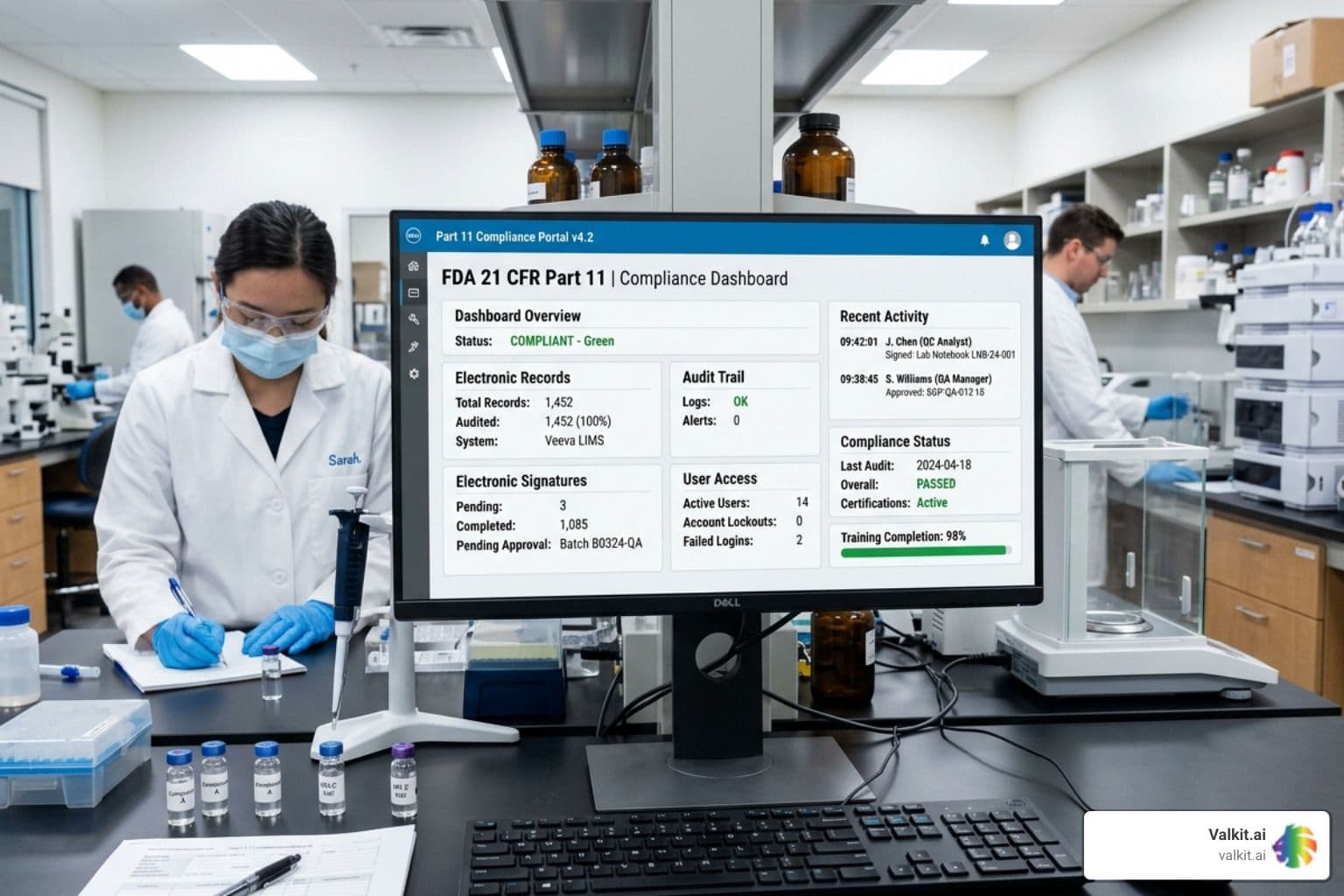
Part 11 Compliance: How to Keep Your Electronic Records FDA-Friendly | Valkit.ai
Part 11 Compliance: How to Keep Your Electronic Records FDA-Friendly
Achieve 21 CFR Part 11 compliant systems. Master electronic records, signatures, validation, and FDA audit readiness with expert best practices.
Steve Ferrell·
What It Means to Be 21 CFR Part 11 Compliant
Being 21 CFR Part 11 compliant means your organization meets the FDA's requirements for using electronic records and electronic signatures in place of paper records. Here is what that requires at a glance:
Requirement What It Means System Validation Prove your system works accurately and reliably Audit Trails Automatically log who changed what, when, and why Electronic Signatures Unique, identity-verified, legally binding sign-offs Access Controls Only authorized users can view or modify records Record Integrity Records must be tamper-evident and retrievable SOPs and Training Staff must be trained and procedures must be documented
If you manage electronic records for an FDA-regulated product — pharmaceuticals, medical devices, biologics, or clinical research — this regulation applies to you. And getting it wrong can mean warning letters, audit failures, or worse.
21 CFR Part 11 has been in effect since August 20, 1997. Yet many validation teams still struggle with what it actually requires, which systems it covers, and how far they need to go to satisfy an FDA inspector.
The confusion is understandable. The regulation is dense, the FDA's own enforcement has shifted over time, and the line between "compliant enough" and "over-engineered" is not always obvious. Early in the regulation's history, companies scrambled to respond to audit findings and keynote warnings, often investing heavily in incomplete or misaligned solutions.
This guide cuts through that noise.
I'm Stephen Ferrell, Chief Product Officer at Valkit.ai, and I've spent over 20 years guiding pharmaceutical, biotech, and medical device organizations through computerized system validation and 21 CFR Part 11 compliant implementations. As a contributing author to ISPE GAMP 5 Second Edition and chair of GAMP Americas, I'll walk you through exactly what compliance requires — and how to achieve it without wasting time or resources.
Steve Ferrell
Chief Product Officer
Understanding the Scope of 21 CFR Part 11 Compliant Systems
To get a handle on this regulation, we first have to understand what it actually covers. At its heart, 21 C.F.R. Part 11 — Electronic Records; Electronic Signatures — Federal Regs is designed to ensure that electronic records are just as trustworthy and reliable as their old-fashioned paper counterparts.
But not every single spreadsheet or Word doc in your office is subject to these rules. The "trigger" for compliance is something called predicate rules.
What are Predicate Rules?
A predicate rule is any other FDA regulation that requires you to maintain certain records. For example:
21 CFR 211 (cGMP): Current Good Manufacturing Practice for finished pharmaceuticals.
21 CFR 820 (QMSR): Quality Management System Regulation for medical devices.
21 CFR 58 (GLP): Good Laboratory Practice for nonclinical studies.
If a predicate rule says, "You must keep a record of this batch test," and you decide to store that record digitally instead of on paper, then Part 11 kicks in. According to Title 21 CFR Part 11, the regulation applies to records created, modified, maintained, archived, retrieved, or transmitted under FDA requirements.
This covers a wide range of players in the life sciences space, including:
Pharmaceutical and biotech manufacturers.
Medical device firms.
Clinical Research Organizations (CROs).
Contract laboratories and research sites.
Even certain food safety documentation (like HACCP records) if maintained electronically.
Technical Controls for a 21 CFR Part 11 Compliant Environment
The regulation distinguishes between two types of systems, each requiring different levels of control:
Closed Systems: An environment where system access is controlled by the people responsible for the content of the electronic records. Most internal company networks, LIMS, and QMS platforms fall into this category.
Open Systems: An environment where system access is not controlled by the persons responsible for the record content (think: records traveling over the open internet). These require extra layers of security, such as document encryption and digital signature standards, to ensure authenticity.
To be 21 CFR Part 11 compliant, a closed system must implement specific technical controls. These include authority checks (ensuring only people with the right "clearance" can perform certain actions) and device checks (verifying that the source of data input is valid). We also look for "operational checks" to enforce the correct sequence of steps—for example, you shouldn't be able to sign off on a result before the test data has actually been entered!
Implementing 21 CFR Part 11 Compliant Electronic Signatures
Subpart C of the regulation deals specifically with electronic signatures. For a signature to be considered the legal equivalent of a handwritten one, it must meet several criteria:
Uniqueness: A signature must be unique to one individual and never reused or reassigned.
Identity Verification: Before we hand out a username and password, we have to verify that the person is who they say they are.
Two-Component Authentication: For non-biometric signatures (like a password), each signing session must require at least two distinct components—usually an ID code and a password.
Signature Manifestations: When you look at a signed electronic record, it must clearly show the printed name of the signer, the date and time the signature was executed, and the "meaning" of the signature (e.g., review, approval, or authorship).
We also must certify to the FDA that we intend our electronic signatures to be legally binding. This is a one-time administrative step, but it's a critical part of Ensuring Industry Compliance: GMO Sign and FDA's 21 CFR Part 11. If you don't tell the FDA you're using them, they might not recognize them during an inspection.
The Role of System Validation and Audit Trails
Validation is often the most misunderstood part of being 21 CFR Part 11 compliant. In the simplest terms, validation is providing documented evidence that a system does exactly what it's supposed to do, consistently.
From CSV to CSA: A Modern Shift
For decades, the industry relied on "Computer System Validation" (CSV), which often involved mountains of paper and "testing for the sake of testing." However, the FDA’s recent focus has shifted toward Computer Software Assurance (CSA).
The CSA approach, highlighted in 2025 guidance, encourages a risk-based approach. Instead of testing every single button on a screen, we focus our energy on the functions that directly impact patient safety and data integrity. This "un-drags" the process, as discussed in Validation and 21 CFR Part 11 Without the Drag.
Feature Traditional CSV Modern CSA Focus Documentation and "scripted" testing Critical thinking and risk to patient safety Effort Heavy on low-risk features Proportional to risk level Testing Mostly formal, scripted scripts Mix of unscripted, exploratory, and scripted Goal Compliance via paperwork Assurance via system performance
The "Why" Behind Audit Trails
If validation is the "proof of performance," the audit trail is the "proof of history." A 21 CFR Part 11 compliant audit trail must be secure, computer-generated, and time-stamped. It must record:
Who made the change.
What was changed (capturing both the old and new values).
When it happened.
Why it happened (the reason for the change).
Crucially, an audit trail must be "immutable." This means users—even administrators—should not be able to edit or delete the logs. These records must be retained for at least as long as the subject record and must be available for FDA review. If an inspector asks to see the history of a specific lab result and you can't show them who edited it three weeks ago, you have a major compliance gap.
FDA Enforcement Discretion and Predicate Rules
In 2003, the FDA realized that the industry was struggling with the sheer cost and complexity of Part 11. To fix this, they released a "Scope and Application" guidance document. This introduced the concept of enforcement discretion.
According to the Part 11, Electronic Records; Electronic Signatures - Scope and Application | FDA, the agency currently takes a "narrow interpretation" of the rule. This means they focus their enforcement on the most critical parts of the regulation while being a bit more flexible on others—provided you are still following the predicate rules.
Key Areas of Enforcement Discretion:
Legacy Systems: Systems that were operational before August 20, 1997, might be exempt from certain Part 11 requirements if they met predicate rules then and continue to do so now. However, you must have documented "fitness for use."
Validation and Audit Trails: While the FDA still expects these, they won't necessarily penalize you for minor technical gaps if you can prove through a risk assessment that the data is still secure and reliable.
Copies of Records: You must be able to provide the FDA with "human-readable" copies of your records (like a PDF or XML file) that preserve all the content and meaning of the original.
The takeaway here isn't that you can ignore the rules. It's that you should use a risk-based approach. If a system manages critical clinical trial data, we need to be 100% compliant. If it's a word processor used only to draft SOPs that are later printed and signed on paper, the requirements are much lower.
Best Practices for Maintaining Compliance and Audit Readiness
Achieving compliance is one thing; maintaining it is another. Many companies fail not because their software is bad, but because their "procedural controls" (the human side of things) fall apart.
The Shared Responsibility Model
If you use a SaaS (Software as a Service) platform, compliance is a shared responsibility. The vendor provides the "Part 11-ready" tools (like audit trails and encryption), but you are responsible for:
Validation: You must validate the software for your specific "intended use."
SOPs: You need written procedures for how the system is used and managed.
Training: You must prove that every user has been trained and understands their accountability when using an electronic signature.
Shared Credentials: Never, ever let staff share a login. This destroys the "uniqueness" of the signature and makes it impossible to hold individuals accountable.
Hybrid Workflows: Mixing paper and digital can be messy. If you print a digital record to sign it on paper, that paper becomes the "authoritative" record, and you must ensure it's a complete and accurate copy.
Neglecting Audit Trail Reviews: It’s not enough to have an audit trail; you have to periodically review it to look for unauthorized changes or errors.
Preparing for an Audit
To be audit-ready, we recommend conducting a gap analysis. Look at your current systems and ask:
Is it validated?
Does it have a secure audit trail?
Are the signatures linked to the records?
Is there a training record for every user?
If you can answer "yes" to all four, you're in a very good position.
Frequently Asked Questions about Part 11
Who is required to comply with 21 CFR Part 11?
Any organization regulated by the FDA that chooses to maintain records or submit signatures electronically instead of on paper. This includes pharmaceutical companies, medical device manufacturers, biotech firms, CROs, and clinical labs.
What are predicate rules and how do they trigger compliance?
Predicate rules are the underlying FDA regulations (like cGMP or GLP) that mandate record-keeping. If a predicate rule requires a record, and you store that record in a digital system, then 21 CFR Part 11 compliance is triggered for that system.
What is the difference between 21 CFR Part 11 and EU Annex 11?
While both aim for data integrity, 21 CFR Part 11 is a US regulation, whereas EU Annex 11 is the European equivalent. Annex 11 is generally more focused on the management of the system and risk, while Part 11 is more prescriptive about technical signature requirements. Most modern systems are designed to satisfy both simultaneously.
Conclusion
Navigating 21 CFR Part 11 compliant systems doesn't have to be a nightmare of red tape and endless paperwork. By focusing on the "why" behind the regulation—ensuring that digital data is as trustworthy as ink on paper—we can build systems that are both compliant and efficient.
Compliance provides more than just "peace of mind" during an inspection; it fosters better data reliability and operational efficiency. When you trust your data, you can make better decisions for your products and, ultimately, for the patients who rely on them.
At Valkit.ai, we understand that traditional validation is slow and expensive. Our AI-powered digital validation platform is specifically built for the pharmaceutical, biotech, and medical device industries. We help you reduce validation costs by up to 80% and turn weeks of manual work into hours of smart automation. With our compliance tools and automated cloning, we make staying "FDA-friendly" easier than ever.
Ready to leave the paperwork behind? Start your digital validation journey with us today and see how smart automation can transform your compliance strategy.