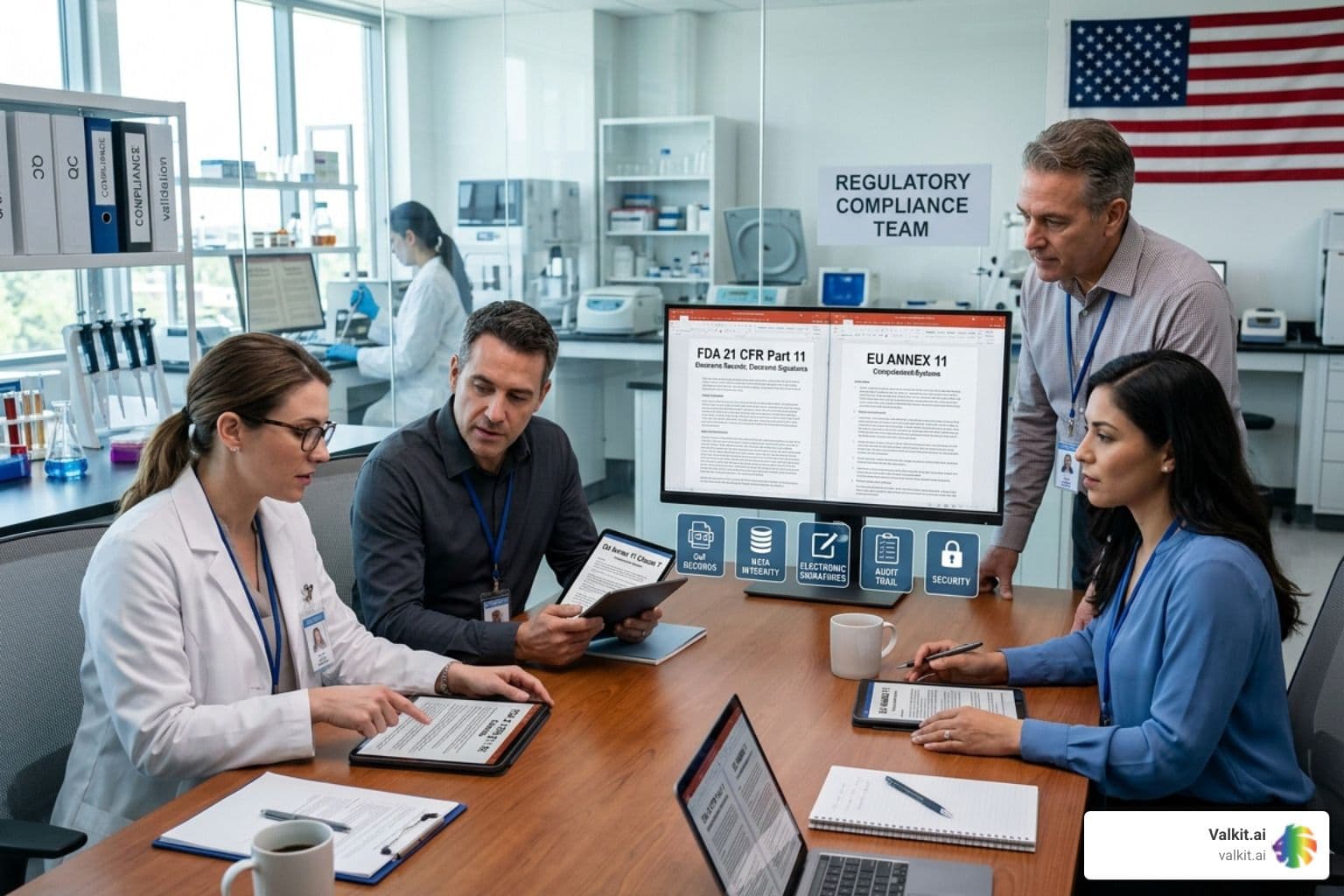
Lost in Translation? Critical Differences Between Part 11 and Annex 11 | Valkit.ai
Lost in Translation? Critical Differences Between Part 11 and Annex 11
Discover annex 11 vs part 11 differences: FDA 21 CFR Part 11 vs EU Annex 11. Master compliance strategies for global pharma operations.
Steve Ferrell·
Why the Difference Between Annex 11 vs Part 11 Matters for Global Validation Teams
Annex 11 vs Part 11 are two separate regulatory frameworks that govern computerized systems and electronic records in life sciences — one from the US FDA, one from the EU. Here is a quick breakdown:
21 CFR Part 11EU GMP Annex 11Issued by US FDA European Medicines Agency (EMA) Legal status Legally binding regulation Guidance (treated as binding in inspections) First published 1997 1992, revised 2011 Focus Electronic records and electronic signatures Computerized systems across their full lifecycle Approach Prescriptive ("thou shalt") Risk-based and principles-based ("how to") Audit trails Required for all electronic records Required for critical data based on risk assessment Risk management Implied through broader GMP rules Explicitly required and documented Applies to All FDA-regulated industries Human and veterinary medicinal products in the EU
If you sell or manufacture in both the US and EU markets, you need to meet both frameworks — and the differences between them can create real compliance gaps if you are not careful.
Part 11 tells you exactly what to do. Annex 11 tells you to figure out what matters most and manage it intelligently. Neither approach is easier — they just require different thinking.
Global validation teams often struggle with exactly this translation problem: building one system that satisfies two different regulatory philosophies without doubling the work.
I am Stephen Ferrell, Chief Product Officer at Valkit.ai and Chair of GAMP Americas, with over two decades of hands-on experience guiding life sciences organizations through the nuanced expectations of annex 11 vs part 11 compliance across global markets. In that time, I have seen how the gaps between these two frameworks create costly delays, redundant documentation, and audit vulnerabilities for validation teams operating without the right framework in place.
Steve Ferrell
Chief Product Officer
Understanding the Foundations: FDA 21 CFR Part 11 and EU Annex 11
When we talk about annex 11 vs part 11, we are looking at two different "languages" of compliance.
FDA 21 CFR Part 11 was finalized in 1997. Its primary goal was to allow pharmaceutical and medical device companies to use electronic records and signatures instead of paper. At the time, the FDA wanted to ensure that an electronic signature was just as legally binding and trustworthy as a "wet ink" signature on a piece of paper. Because it is a federal regulation, it is legally binding. If you don't follow it, you are breaking the law.
On the other side of the Atlantic, EU GMP Annex 11 is part of EudraLex Volume 4, which provides guidelines for Good Manufacturing Practice (GMP). While Annex 11 is technically a "guidance" document rather than a law, don't let that fool you. In the eyes of an EU inspector, it is effectively mandatory. If you are manufacturing medicinal products for the European market, failing to follow Annex 11 is a surefire way to fail an inspection. For a useful regulatory overview, the European Commission EudraLex Volume 4 GMP guidelines provide the official framework behind Annex 11.
The biggest fundamental difference is their starting point. The FDA focuses heavily on the integrity of the record (the data), while the EU focuses on the control of the system (the computer and the processes). Part 11 is often described as "prescriptive," meaning it gives you a specific checklist of technical controls. Annex 11 is "principles-based," meaning it tells you what the outcome should be (no increase in risk to the patient) and asks you to prove how you got there.
The Scope of FDA 21 CFR Part 11
If your company operates in the US market-perhaps near our team in Indiana-you are likely very familiar with Part 11. It applies to all FDA-regulated industries, including pharma, biotech, and medical devices.
The scope is divided into three main subparts:
Subpart A (General Provisions): Defines when the regulation applies and what terms like "closed system" and "open system" mean.
Subpart B (Electronic Records): Sets the rules for how you must control your systems to ensure records are authentic and reliable. This includes validation, audit trails, and authority checks.
Subpart C (Electronic Signatures): Outlines the requirements for digital signatures, ensuring they are unique to one individual and cannot be forged or reused by someone else.
The goal here is "trustworthy records." The FDA wants to know that if they look at a digital file five years from now, it is exactly the same as it was the day it was created.
The Scope of EU GMP Annex 11
For those of us working with European partners-including our colleagues in Scotland-Annex 11 is the gold standard. Its scope is broader than Part 11 because it doesn't just look at the records; it looks at the entire "computerized system." This includes the hardware, software, the people operating it, and the procedures they follow.
Annex 11 is structured around a lifecycle approach. It covers:
Risk Management: You must perform a documented risk assessment to decide how much validation is needed.
Personnel: Everyone involved must have the right qualifications and access levels.
Suppliers: If you use a third-party software (like a cloud-based eQMS), you are responsible for qualifying that vendor.
In short, Annex 11 cares about the "why" and the "how" just as much as the "what."
Annex 11 vs Part 11: A Side-by-Side Comparison
When comparing annex 11 vs part 11, it helps to think of them as two different styles of parenting. Part 11 is the strict parent who gives you a 10:00 PM curfew and checks your odometer. Annex 11 is the parent who says, "I trust you to be safe, but show me your plan for the evening and tell me how you’ll handle emergencies."
One major area where they align is the use of ALCOA+ principles. Both frameworks expect data to be:
Attributable (Who did it?)
Legible (Can I read it?)
Contemporaneous (Was it recorded at the time?)
Original (Is it the first record?)
Accurate (Is it correct?)
Plus: Complete, Consistent, Enduring, and Available.
However, the enforcement trends differ. The FDA often focuses on technical failures—like disabled audit trails or shared passwords. EU inspectors are more likely to dig into your vendor audits and your risk management documentation.
Key Differences in Audit Trails and Validation for Annex 11 vs Part 11
The audit trail is often where companies get "lost in translation."
Under 21 CFR Part 11, you are generally required to have secure, computer-generated, time-stamped audit trails for all electronic records. There isn't much wiggle room here. If a piece of data is part of a GxP record, it needs an audit trail.
EU Annex 11 takes a slightly different path. It requires audit trails for "relevant" changes and "critical" data. How do you know what is critical? You use a risk assessment. This gives you more flexibility, but it also puts the burden of proof on you. You have to explain to an inspector why you decided not to have an audit trail for a specific function.
Validation approaches also vary. Annex 11 explicitly mentions the "lifecycle" of the system, aligning closely with GAMP 5 (Good Automated Manufacturing Practice). It requires you to have User Requirements Specifications (URS), formal change control, and periodic reviews to ensure the system stays in a validated state. While the FDA expects these things too, they are often covered under "predicate rules" (like Part 211 for pharma) rather than Part 11 itself.
Electronic Signatures and Risk Management: Annex 11 vs Part 11
Both regulations agree that an electronic signature should be legally equivalent to a handwritten one. To achieve this, they both require "two-component identification"—usually a username and a password.
However, Annex 11 goes a step further in its 2011 revision by emphasizing the "manifestation" of the signature. This means the printed name of the signer, the date/time (including time zone), and the meaning of the signature (e.g., "Review," "Approval," or "Author") must be clearly visible.
Risk management is the biggest "gap" in annex 11 vs part 11. Annex 11 Section 1 is dedicated entirely to risk management, citing ICH Q9. It mandates that you justify your validation effort based on the risk to patient safety and product quality. Part 11 doesn't mention the word "risk" once, though the FDA’s 2003 "Scope and Application" guidance clarified that they expect a risk-based approach in practice.
One practical tip we always give our clients: if you are using a hybrid system (where you sign on paper but store data electronically), you have to be extra careful. Annex 11 is particularly strict about ensuring that the link between the electronic record and the physical signature is unbreakable.
Achieving Global Compliance: Strategies for Dual-Market Operations
If your company operates globally, trying to maintain two separate sets of SOPs (Standard Operating Procedures) for annex 11 vs part 11 is a recipe for disaster. It’s confusing for staff and doubles the chance of a mistake.
Instead, we recommend building a Unified Compliance Framework. The secret is to always default to the strictest requirement from either regulation.
For example:
Audit Trails: Default to the Part 11 requirement of logging everything, but use the Annex 11 risk-based approach to determine how often those logs need to be reviewed.
Vendor Management: Follow the Annex 11 requirement for formal supplier qualification and written agreements. This will satisfy the FDA’s general expectations for purchasing controls while meeting the EU’s specific demands.
Validation: Use a lifecycle approach (GAMP 5). This satisfies Annex 11’s explicit requirements and provides the "trustworthy" evidence the FDA looks for.
Digital tools play a massive role here. Modern electronic Quality Management Systems (eQMS), Manufacturing Execution Systems (MES), and Laboratory Information Management Systems (LIMS) are often built with these "dual" requirements in mind.
At Valkit.ai, we’ve seen how AI-powered platforms can bridge this gap. Instead of spending weeks manually mapping Annex 11 clauses to Part 11 requirements, our platform uses smart automation to clone compliant workflows and generate validation documentation that satisfies both US and EU inspectors. This can reduce validation costs by up to 80%, moving your team from "weeks of paperwork" to "hours of oversight."
Frequently Asked Questions about Annex 11 and Part 11
Which regulation is more difficult to follow?
It depends on your team’s strengths! Many find 21 CFR Part 11 "harder" because it is so prescriptive—there is a right way and a wrong way, and the FDA isn't afraid to issue a Form 483 if you miss a technical detail. Others find Annex 11 more challenging because it requires you to think critically and document your logic. You can't just follow a checklist; you have to defend your risk assessments to an inspector.
Do these regulations apply to spreadsheets and mobile devices?
Yes! This is a common "gotcha." If you are using an Excel spreadsheet to calculate a batch yield or track a CAPA, that spreadsheet is a "computerized system." It needs to be locked, validated, and have an audit trail. The same applies to mobile devices or tablets used on the manufacturing floor. If GxP data touches the device, the device is in scope for annex 11 vs part 11.
What are the consequences of non-compliance?
In the US, the FDA can issue Warning Letters, import bans, or even seize products. In the EU, non-compliance can lead to the withdrawal of your Manufacturing Authorization, meaning you can no longer sell your product in the 27 member states. Beyond the legal trouble, the biggest risk is to your reputation and patient safety. Data that isn't trustworthy leads to bad decisions.
Conclusion
Navigating the nuances of annex 11 vs part 11 doesn't have to feel like you're lost in translation. While the US and EU have different regulatory histories and "philosophies," they both have the same ultimate goal: ensuring that digital technology makes medicine safer, not riskier.
The trend for the future is "Harmonization." We are already seeing this with the new draft revisions of Annex 11, which aim to align more closely with modern technology like Cloud computing and AI, while mirroring some of the FDA's focus on data integrity.
For global companies, the path forward is clear: move away from manual, paper-heavy validation and embrace digital transformation. By using a unified framework and the right automation tools, you can stay inspection-ready in Indiana, Scotland, and everywhere in between.
Are you ready to stop worrying about regulatory gaps and start accelerating your time-to-market? Start your automated validation journey with Valkit.ai and see how we can turn your compliance burden into a competitive advantage.