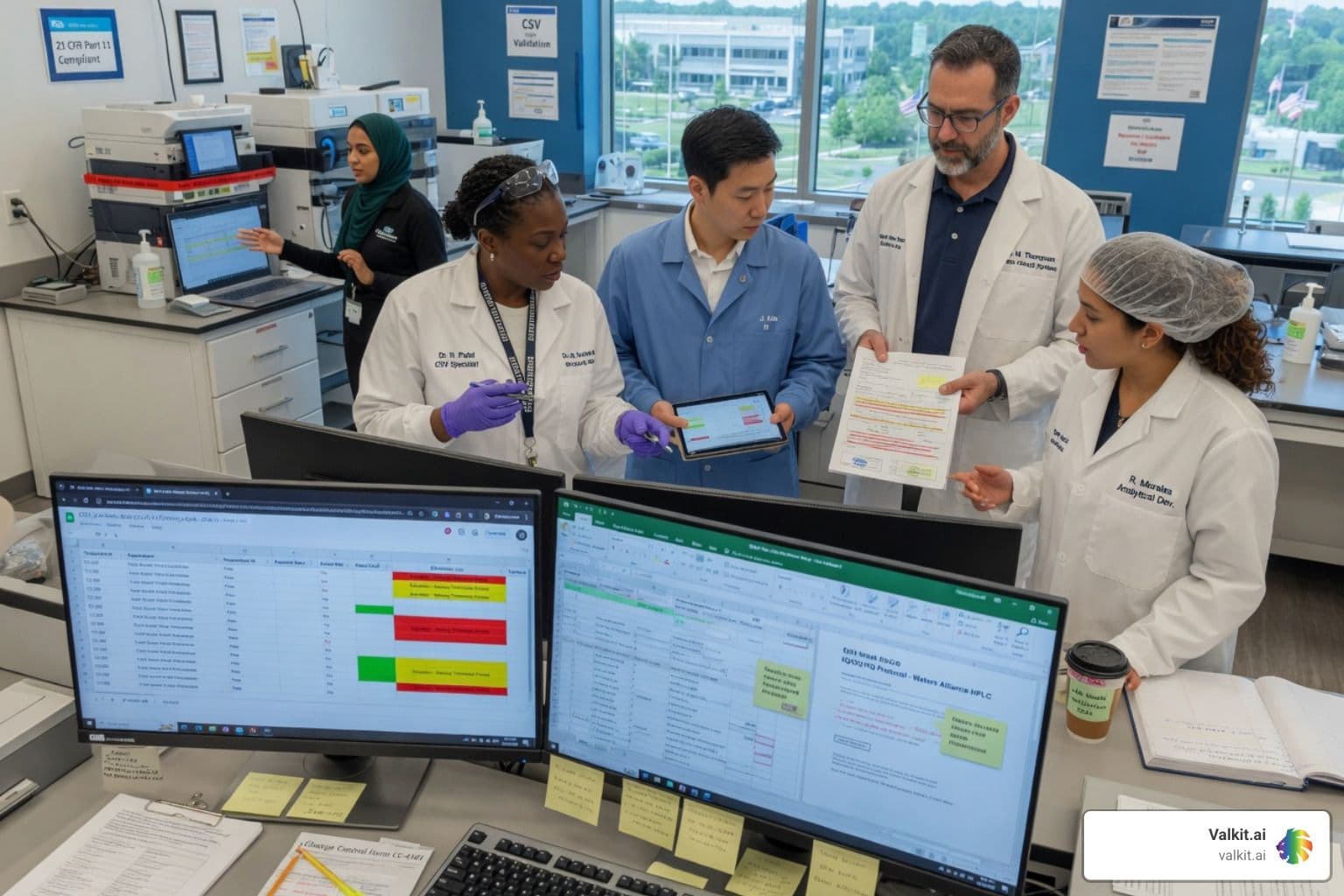
Everything You Need to Know About Computer System Validation | Valkit.ai
Everything You Need to Know About Computer System Validation
Master CSV in pharma: GAMP 5, CSA transition, IQ/OQ/PQ, data integrity & automation for GxP compliance.
Steve Ferrell·
What Is CSV in Pharma? A Clear Answer Before We Dive In
CSV in pharma — or Computer System Validation — is the documented process of proving that a computerized system consistently does what it is designed to do, in compliance with regulatory requirements like FDA 21 CFR Part 11 and EU Annex 11.
Here is a quick-reference summary:
What it stands for Computer System Validation Primary purpose Ensure computerized systems are accurate, reliable, and compliant Who requires it FDA, EMA, MHRA, and other global health regulators Key framework GAMP 5 (published by ISPE) Systems it covers LIMS, MES, ERP, QMS, CTMS, and more Core principle Data integrity via ALCOA+ Modern evolution Computer Software Assurance (CSA) — a risk-based, less document-heavy approach
If your company uses any computerized system that touches product quality, patient safety, or regulated data, CSV applies to you. No exceptions.
The pharmaceutical industry is one of the most tightly regulated sectors on the planet — and for good reason. A single data error in a manufacturing system or a lab database can ripple outward into real patient harm. That is why regulators do not just recommend that computer systems be validated. They require it.
Yet for many validation managers, CSV feels less like a safety net and more like a bottleneck. Mountains of documentation, months-long timelines, steep learning curves, and manual processes that drain teams of time and resources. The frustration is real — and it is exactly why the field is evolving fast.
This guide covers everything: the regulatory foundations, the GAMP 5 lifecycle, the shift to CSA, and how modern automation tools are compressing what used to take months into days.
I'm Stephen Ferrell, Chief Product Officer at Valkit.ai, with over 20 years of hands-on experience guiding pharmaceutical, biotech, and medical device organizations through csv in pharma — including co-founding CompliancePath, contributing to ISPE GAMP 5 Second Edition, and chairing GAMP Americas. I've spent my career at the intersection of regulatory compliance and technology, which is exactly the lens through which this guide is written.
Steve Ferrell
Chief Product Officer
Understanding the Regulatory Necessity of CSV
In life sciences, if it isn’t documented, it didn’t happen. But in csv in pharma, if it isn't validated, it isn't trusted.
Regulatory bodies like the FDA in the United States and the EMA in Europe (governing regions including Scotland) view computer systems as "equipment." Just as you wouldn't use a rusty, uncalibrated scale to weigh active pharmaceutical ingredients, you cannot use an unvalidated software system to manage clinical data or manufacturing batches.
The two primary "North Stars" for compliance are:
FDA 21 CFR Part 11: This US regulation establishes the criteria under which electronic records and electronic signatures are considered trustworthy, reliable, and equivalent to paper records. It’s the reason why your system needs audit trails and secure logins.
EU Annex 11: Part of the EudraLex Volume 4, this is the European equivalent (highly relevant for our partners in Scotland). It emphasizes a risk-based approach, stating that when a computerized system replaces a manual operation, there should be no resultant decrease in product quality or process assurance.
Beyond just "following the rules," there are tangible Benefits Of Csv In Pharma. A validated system reduces the risk of data corruption, improves operational efficiency, and ensures that when an auditor knocks on your door, you have a clear, defensible story to tell. However, achieving this isn't without its hurdles, as detailed in this look at CSV in Pharmaceuticals: Challenges and Solutions.
The Role of ALCOA+ in Data Integrity
At the heart of csv in pharma is data integrity. We often use the acronym ALCOA+ to define what "good" data looks like. If your system cannot guarantee these principles, it cannot be validated.
Attributable: Who recorded the data and when?
Legible: Can the data be read and understood years later?
Contemporaneous: Was the data recorded at the time the work was performed?
Original: Is it the primary source or a certified true copy?
Accurate: Is the data correct and free from errors?
The "+" adds Complete, Consistent, Enduring, and Available. We discuss how these principles integrate into modern software in our guide on Csv Pharma.
Consequences of Non-Compliance
What happens if you skip a step? In Indiana, Scotland, or anywhere else, the consequences are severe.
FDA 483 Observations: These are "concerns" noted during an inspection.
Warning Letters: A formal escalation that can halt production.
Product Recalls: If a system error leads to a quality defect, you may have to pull products off the shelf.
Regulatory Fines: These can reach into the millions.
The goal is patient safety. A system that fails to record a temperature excursion in a vaccine fridge isn't just a "software bug"—it's a public health risk. You can read more about the European specifics of these requirements in our breakdown of Annex 11 Csv.
The GAMP 5 Lifecycle and V-Model Approach
If regulations tell us what to do, GAMP 5 tells us how to do it. GAMP (Good Automated Manufacturing Practice) is not a law, but it is the industry-standard "recipe book" for Csv Computerized System Validation.
The core of GAMP 5 is the V-Model. Think of it as a bridge. On the left side, you define what you need (specifications). On the right side, you test to make sure you got it (qualification).
GAMP 5 Software Categories
Not all software is created equal. You wouldn't validate a simple calculator the same way you’d validate a custom-coded AI for drug discovery.
Category Type Validation Effort Example Category 1 Infrastructure Software Low (Verify installation) Operating systems, Database engines Category 3 Non-Configured Software Medium (Test against URS) Off-the-shelf tools, simple lab equipment Category 4 Configured Software High (Risk-based testing) LIMS, ERP, MES (Standard but tailored) Category 5 Bespoke (Custom) Software Very High (Full lifecycle) Custom-coded applications for specific processes
Note: Category 2 was discontinued in GAMP 5 because it was rarely used.
Key Systems Requiring csv in pharma Validation
In a modern pharmaceutical environment, almost everything is digital. We regularly help companies validate:
LIMS (Laboratory Information Management Systems): For tracking samples and test results.
MES (Manufacturing Execution Systems): For managing the "shop floor" and batch records.
ERP (Enterprise Resource Planning): For managing the supply chain and logistics.
QMS (Quality Management Systems): For handling deviations, CAPAs, and audits.
CTMS (Clinical Trial Management Systems): For managing patient data in trials.
The "V-Model" culminates in three critical phases of testing:
IQ (Installation Qualification): "Is it installed correctly?" We check the hardware, the software version, and the environment. If you’re in Indiana and your server is in Scotland, we verify the connection and configuration.
OQ (Operational Qualification): "Does it work as intended?" We test every button, every alarm, and every security setting. This is where we try to "break" the system by entering invalid data to see if it catches the error.
PQ (Performance Qualification): "Does it work consistently in the real world?" We test the system under actual load, using real-world scenarios to ensure it stays stable over time.
Linking all of this together is the User Requirements Specification (URS) and the Traceability Matrix. The matrix is your map; it proves that every single requirement you wrote down at the start was actually tested and passed at the end.
Transitioning from CSV to Computer Software Assurance (CSA)
The industry is currently undergoing a massive shift. For years, csv in pharma focused heavily on the documentation—the "paper trail." This often led to teams spending 80% of their time writing reports and only 20% of their time actually testing the software.
The FDA’s emerging Computer Software Assurance (CSA) approach flips this script. CSA encourages "critical thinking" over "check-the-box" documentation.
The Core Differences
CSV: Focuses on producing a massive volume of scripted test cases to satisfy auditors.
CSA: Focuses on the risk to patient safety and product quality. If a feature is low-risk (like the color of a dashboard), you might use unscripted testing. If it’s high-risk (like a formula calculation), you use rigorous scripted testing.
Vendor Audits: If a software provider (like a major cloud ERP) has already done extensive testing, why repeat it all? We can "credit" their work.
Unscripted Testing: For low-risk functions, a simple log of "tested and passed" is often enough.
Automated Testing: Using tools to run thousands of tests in seconds rather than having a human click through screens for weeks.
CSA Benefits for Agility:
Faster implementation of new technologies.
Reduced "validation fatigue" for quality teams.
Better focus on high-risk areas that actually impact the patient.
Lower overall project costs.
The Evolution and Future of csv in pharma
We are entering the era of Validation 4.0. Gone are the days of three-ring binders filled with thousands of printed pages of test results. The future is digital, automated, and AI-driven.
At Valkit.ai, we are at the forefront of this evolution. By utilizing Pharmaceutical Csv Automation Tools, we’ve seen companies reduce their validation costs by up to 80%. What used to take a team of consultants six months can now be achieved in a matter of hours through smart cloning and automated protocol generation.
Overcoming Common Challenges in csv in pharma
Even with new tools, some challenges remain:
Legacy Systems: Old software that wasn't built for modern audit trails.
Cybersecurity: Protecting validated data from hackers is now a core part of the validation process.
Resource Intensity: Finding people who understand both "Pharma Quality" and "IT Systems" is hard.
Digital validation tools solve these problems by providing standardized templates and automated workflows that guide even non-experts through the process safely.
AI and Automation in Validation 4.0
The next step is Continuous Validation. Instead of validating a system once and then ignoring it for two years, AI can monitor the system in real-time.
Machine Learning: Can predict which parts of a system are most likely to fail based on historical data.
Predictive Risk Analysis: Identifying "hot spots" in your software before they cause a deviation.
Automated Test Execution: Whenever a software patch is released, the system automatically re-validates itself and produces a new report.
This real-time monitoring ensures that your system is always in a validated state, not just on the day the auditors show up.
Frequently Asked Questions about CSV
What is the difference between CSV and CSA?
CSV (Computer System Validation) is the traditional, documentation-heavy approach. CSA (Computer Software Assurance) is the modern, risk-based approach that prioritizes critical thinking and actual testing over excessive paperwork. CSA is effectively the "lean" version of CSV.
Is GAMP 5 a legal requirement in the pharmaceutical industry?
No. GAMP 5 is a set of guidelines, not a law. However, it is so widely accepted by regulators (like the FDA and MHRA) that following it is considered the "gold standard." If you don't follow GAMP 5, you'll need to work much harder to prove to an auditor that your custom method is equally safe.
How often should a validated system undergo periodic review?
There is no hard rule, but the industry standard is typically every 1 to 3 years, depending on the risk level of the system. High-risk systems (like an MES) should be reviewed more frequently than low-risk infrastructure systems. However, with modern continuous monitoring, these "periodic" reviews are becoming a constant, ongoing process.
Conclusion
csv in pharma is no longer just a hurdle to clear; it is a strategic advantage. When done correctly, it ensures data integrity, protects your company from regulatory action, and—most importantly—safeguards the patients who rely on your products.
As we move toward 2026 and beyond, the move from traditional CSV to AI-powered CSA is inevitable. The companies that embrace this shift will be the ones that innovate faster, stay compliant longer, and spend less on "paper-pushing" and more on life-saving research.
Whether you are managing a single LIMS in Indiana or a global ERP rollout from Scotland, the goal remains the same: a validated, reliable, and secure system.