Master GAMP 5 guidance for GxP compliance. Streamline validation, align with FDA CSA, and boost efficiency in life sciences.
Steve Ferrell·
The Evolution and Importance of GAMP 5 Guidance
When we talk about gamp 5 guidance, we aren't just talking about a dry manual sitting on a shelf. We are talking about a living framework that has matured alongside the very technologies it seeks to validate. Since its inception, GAMP (Good Automated Manufacturing Practice) has been the North Star for quality professionals in Scotland, Indiana, and across the globe who need to prove their computerized systems won't fail when a patient's life is on the line.
The Evolution of GAMP 5 Guidance
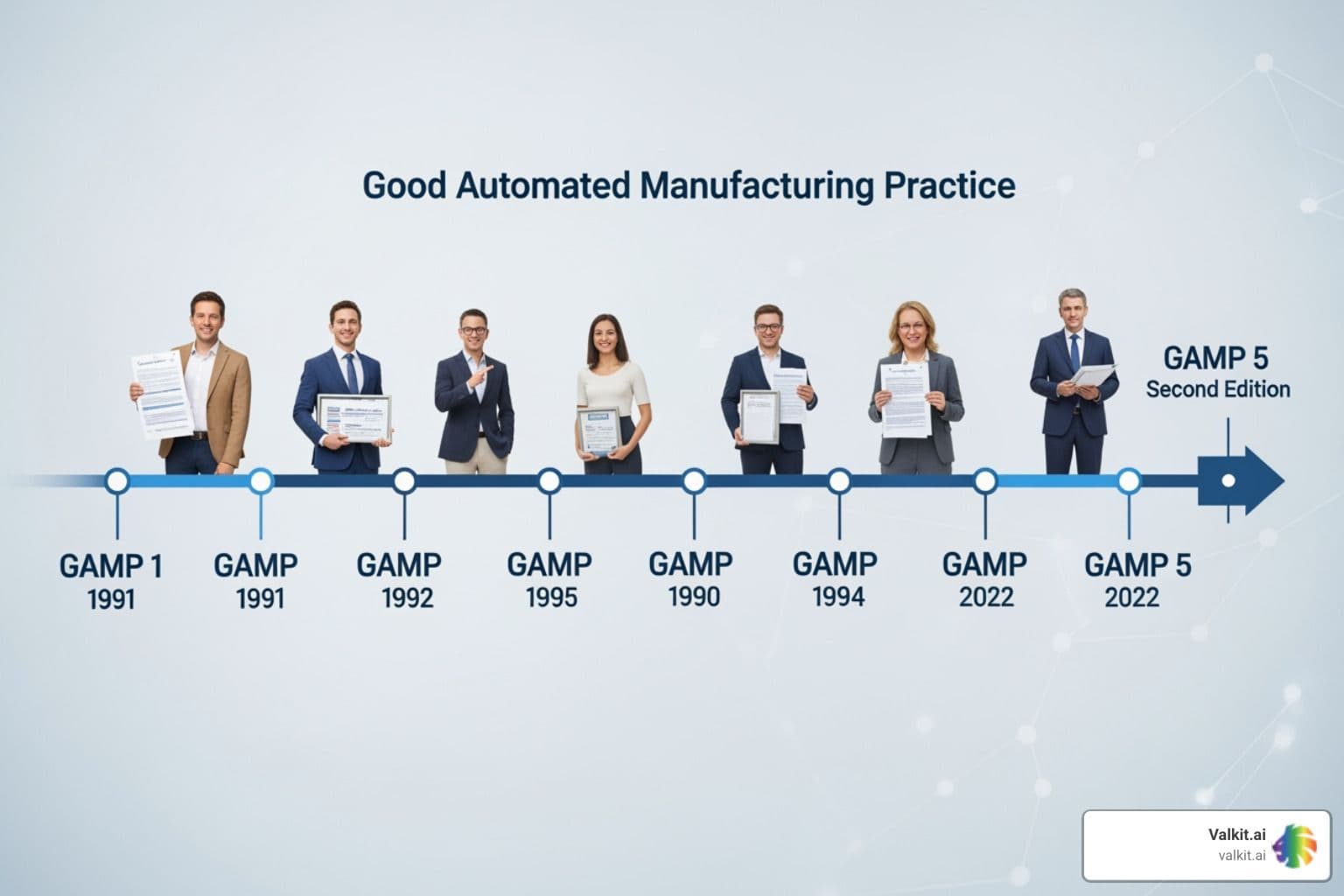
The history of GAMP is a classic "started from the bottom, now we're here" story. It began in the UK in 1991, born out of a desperate need for a common language between pharmaceutical companies and their automation suppliers.
1995: The first formal GAMP guideline was published.
2001: GAMP 4 arrived, introducing more structure.
2008: The original GAMP 5 was released. This was a game-changer because it moved the industry toward a "science-based" risk management approach, aligning with ICH Q8, Q9, and Q10.
This Second Edition is the most significant update in over a decade. It didn’t throw out the old rules; it modernized them. It acknowledges that we no longer live in a world of "paper-on-glass" validation. Today, we have AI, cloud environments, and Agile sprints. The 290-page Second Edition (supported by over 50 appendices) was authored by more than 50 industry experts from giants like Novartis and AstraZeneca to ensure it reflects how modern Life Sciences actually operate.
Why GAMP 5 Matters for Pharma and Biotech
Why do we bother with this? Is it just to keep the regulators happy? Well, partly. But the real benefits of following gamp 5 guidance go much deeper:
Risk Reduction: It helps us identify where a system might actually hurt a patient or ruin a batch of medicine, allowing us to focus our testing there.
ROI and Efficiency: By not "over-validating" low-risk systems, companies save millions. Over-validation is a silent budget killer in our industry.
Steve Ferrell
Chief Product Officer
Scalability: It provides a standardized language. Whether you are a startup in a garage or a global biotech with 150 HPLC instruments, the framework scales with you.
Regulatory Harmonization: While GAMP isn't "the law," it is the "how-to" guide for meeting the law. It helps us comply with FDA 21 CFR Part 11 (electronic records/signatures) and EU GMP Annex 11.
In short, GAMP 5 is the bridge between "we think this software works" and "we have documented proof this software is safe for GxP use."
The Core Framework: Principles, Lifecycle, and Software Categories
At the heart of gamp 5 guidance is the belief that quality shouldn't be tested into a system at the end; it should be built in from the start. This is achieved through a structured approach to the system lifecycle and a clear understanding of what kind of software you are actually dealing with.
[@portabletext/react] Unknown block type "image", specify a component for it in the `components.types` prop
Five Core Principles of GAMP 5 Guidance
We like to think of these as the "Five Commandments" of validation:
Product and Process Understanding: You can't validate a system if you don't understand the medicine it's helping to make. What are the Critical Quality Attributes (CQAs)?
Lifecycle Approach within a QMS: Validation isn't a one-time event (the "Project"). It starts at the "Concept" and ends only when the system is "Retired."
Scalable Lifecycle Activities: This is the "Goldilocks" principle. Don't do too much validation, and don't do too little. Scale your effort based on risk, complexity, and novelty.
Science-Based Quality Risk Management: Use data and critical thinking to decide what to test. If a software glitch can't affect the product or the patient, why are you writing a 50-page test script for it?
Leveraging Supplier Involvement: Your vendors (like us at Valkit.ai!) know their software better than anyone. gamp 5 guidance encourages you to use our documentation and testing to avoid duplicating work.
The System Lifecycle Approach
The lifecycle isn't just a circle; it's a journey through four distinct phases:
Concept: "We need a system to do X."
Project: This is where the heavy lifting happens—User Requirements Specifications (URS), Functional Specifications (FS), and the actual Installation, Operational, and Performance Qualifications (IQ/OQ/PQ).
Operation: The longest phase. This includes change control, periodic reviews, and incident management.
Retirement: How do we get the data out safely before we turn the lights off?
Throughout this journey, a traceability matrix acts as the glue, ensuring every requirement you wrote in the beginning was actually tested in the end.
Software Categorization and Validation Effort
Not all software is created equal. GAMP 5 defines categories to help us determine how much work we need to do. Category 2 (Firmware) was removed in the latest updates as it’s now considered part of the hardware or other categories.
Category Type Description Validation Effort Category 1 Infrastructure Operating systems, database engines, cloud layers. Low (Check version/installation). Category 3 Non-configurable "Off-the-shelf" software used as-is (e.g., a simple calculator). Medium (Verify it fits intended use). Category 4 Configurable Software where you turn features on/off or configure workflows (e.g., an eQMS or ERP). High (Focus on configuration). Category 5 Custom Bespoke code written specifically for your process. Very High (Full design and code review).
Modernizing Validation: V-Model, Agile, and FDA CSA Alignment
For years, the "V-Model" was the undisputed king of validation. But as software development moved toward Agile (sprints, scrums, and rapid releases), the industry worried that GAMP 5 was getting left behind. The Second Edition fixed that.
Modernizing Validation with GAMP 5 Guidance
The new guidance explicitly supports iterative and incremental development. It tells us that we can be Agile and still be compliant. It introduces new appendices for the "hot" tech of today:
Appendix D11 (AI/ML): How do you validate a system that "learns" and changes its own logic?
Appendix D10 (Blockchain): Managing distributed ledgers in a GxP environment.
Appendix M11 (Cloud Computing): Shifting the burden to the Service Provider while maintaining "control."
This shift emphasizes critical thinking over "paper-on-glass" (which is just taking a paper process and doing it on a computer without changing the underlying inefficiency). Digital Validation Beyond Paper-on-Glass is the future we are building at Valkit.ai.
From CSV to CSA: The Efficiency Shift
One of the most exciting alignments is between gamp 5 guidance and the FDA’s Computer Software Assurance (CSA) draft guidance.
Traditional Computer System Validation (CSV) often led to "documentation for the sake of auditors." We’ve all seen it: 80% of the time spent on paperwork and 20% on actual testing. CSA flips the script. The FDA (specifically the CDRH and CBER) wants us to spend 80% of our time testing and only 20% on documentation.
By focusing on "assurance" rather than just "validation," we can use unscripted testing for low-risk features. This means a skilled tester can explore the system and record an "exception-based" report (only documenting when something goes wrong) rather than taking 500 screenshots of "Pass" results. This is the ultimate resource optimization.
Practical Implementation of GAMP 5 Guidance
How do you actually do it? It starts with a shift in mindset: from "how do I pass an audit?" to "how do I make sure this system is safe?"
Risk Management and Supplier Leveraging
Before you write a single test script, perform an initial risk assessment.
Identify Intended Use: What is this software actually for?
Determine Risk: If it fails, does a patient get the wrong dose? Or does a report just look slightly messy?
Leverage the Vendor: If your vendor has already done a full IQ/OQ on their cloud platform, don't do it again. Audit the vendor, review their "Summary Report," and focus your efforts on how you configured the system. This is a core tenet of the GAMP® 5: A Risk-Based Approach to Compliant GxP Computerized Systems Guide.
A Practical Compliance Checklist
If you are starting a validation project today, here is your high-level GAMP 5 "To-Do" list:
Define Requirements (URS): What must the system do? (Be specific! "System must be fast" is not a requirement. "System must load records in < 2 seconds" is.)
Assess the Vendor: Do they have a Quality Management System? Can they support you during an audit?
Perform Risk Assessment: Map your requirements to risks. High-risk requirements get "scripted" (detailed) testing. Low-risk get "unscripted."
Create the Plan: Outline your strategy, including who is responsible for what.
Execute IQ/OQ/PQ: Prove it works. Use digital tools to automate this where possible.
Maintain Control: Implement SOPs for Change Control and Periodic Review. A system is only "validated" if it stays in a validated state.
Frequently Asked Questions about GAMP 5 Guidance
What does GAMP 5 stand for and is it mandatory?
GAMP stands for Good Automated Manufacturing Practice. Version 5 is the current issue. It is not mandatory in a legal sense—you won't find the word "GAMP" in the FDA's Code of Federal Regulations. However, it is the de facto industry standard. If you don't follow it, you'll have to explain to an auditor exactly what "equivalent" framework you are using, which is usually much harder than just following GAMP.
How does GAMP 5 Second Edition differ from the original 2008 version?
The core principles remain the same, but the application has been modernized. The Second Edition (2022) focuses heavily on critical thinking, Agile development, and software tools. It moves away from the "one-size-fits-all" V-model and provides much more guidance on how to handle cloud service providers and "Software as a Service" (SaaS).
How do GAMP 5 software categories determine validation effort?
They act as a roadmap. If you have a Category 3 (non-configurable) system, you might only need to verify the installation and do some basic functional testing. If you have a Category 5 (custom) system, you are essentially responsible for the entire software development lifecycle, including design specs and code reviews. The higher the category, the more "proof" you need that the software was built correctly.
Conclusion
The world of life sciences is moving faster than ever. From the labs in Scotland to the manufacturing plants in Indiana, the pressure to innovate while maintaining absolute safety is immense. gamp 5 guidance isn't a hurdle to that innovation; it's the framework that makes it possible.
By embracing a risk-based approach, leveraging supplier expertise, and moving toward the "assurance" model championed by the FDA, we can stop drowning in paperwork and start focusing on what matters: the science.
At Valkit.ai, we’ve built our platform to live and breathe these principles. Whether it's reducing your validation time from weeks to hours or using AI to automate your risk assessments, we are here to help you navigate the Second Edition with ease. Ready to see how we are ValKit AI - Revolutionizing Validation Execution?
Let’s get your systems validated, compliant, and—most importantly—ready to change the world. Visit us at valkit.ai to learn more.