How to Master the GAMP 5 V Model Shape | Valkit.ai
How to Master the GAMP 5 V Model Shape
Master the GAMP 5 V model: Learn risk-based CSV, software categories, traceability, Agile integration, and GxP compliance for pharma validation.
Steve Ferrell·
Why the GAMP 5 V Model Is the Foundation of Compliant Computerized System Validation
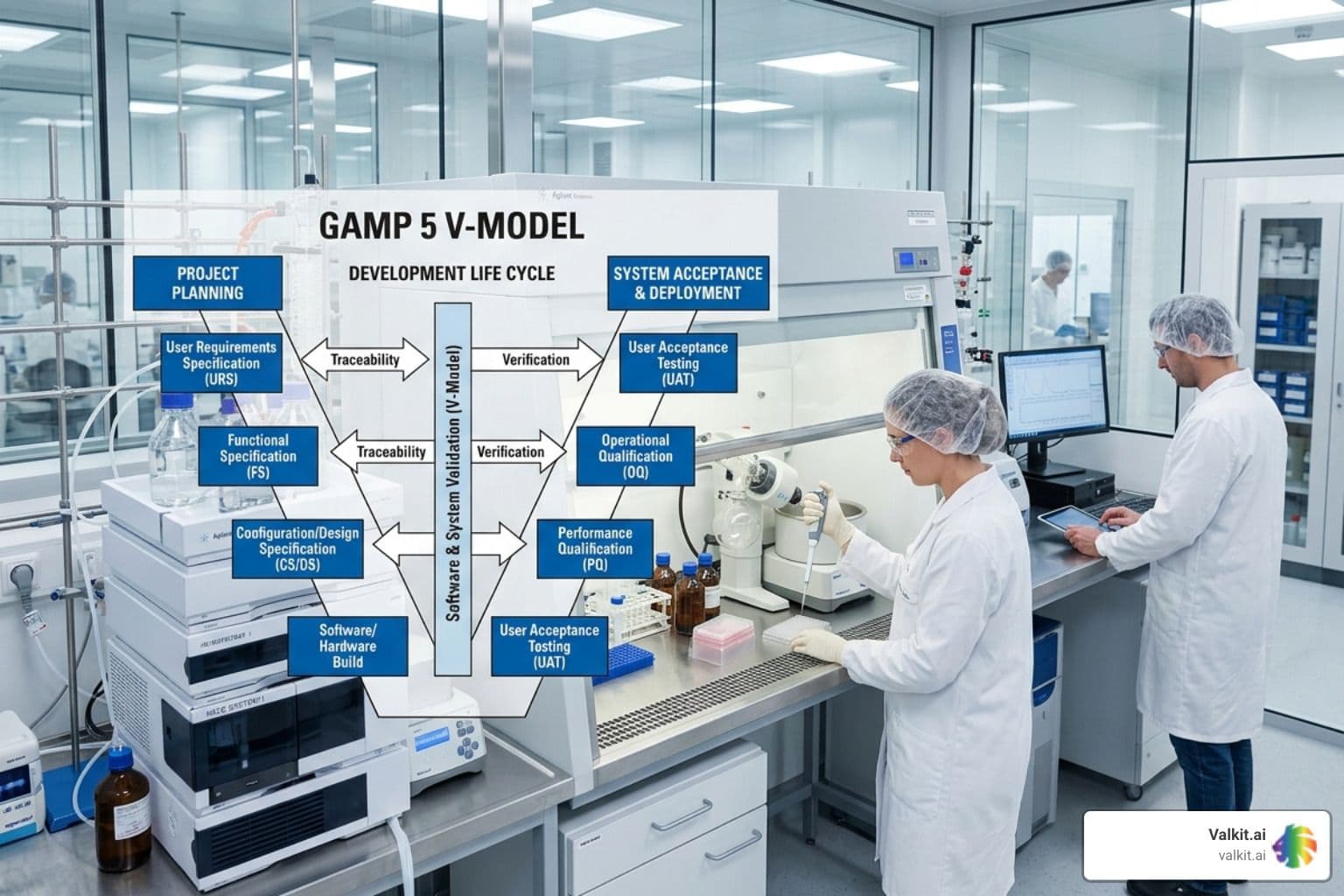
The GAMP 5 V model is a structured framework used in regulated industries — primarily pharmaceuticals, biotech, and medical devices — to validate computerized systems by linking every specification phase to a corresponding testing phase.
Here is a quick summary of how it works:
Left side (specification): Define what the system must do — from User Requirements Specification (URS) through Functional Specification (FS) and Design Specification (DS) down to configuration and coding.
Right side (verification): Test that the system does it — through Installation Qualification (IQ), Operational Qualification (OQ), and Performance Qualification (PQ).
The connection: Each left-side phase maps directly to a right-side test phase, creating a closed loop of traceability.
The goal: Demonstrate that the system is fit for its intended use and meets regulatory requirements like FDA 21 CFR Part 11 and EU GMP Annex 11.
This model sits at the heart of GAMP 5 — the Good Automated Manufacturing Practice guideline published by ISPE — which remains the most widely accepted industry standard for GxP computerized system validation. Data integrity failures are consistently among the top reasons for FDA warning letters, making a rigorous, documented validation approach not just best practice but a business-critical necessity.
The challenge most validation teams face is this: applying the V model correctly, at the right level of effort, without drowning in documentation that adds cost but not quality.
I'm Stephen Ferrell, Chief Product Officer at Valkit.ai and a contributing author to GAMP 5 Second Edition, with over two decades of hands-on experience guiding pharmaceutical and biotech organizations through the GAMP 5 V model and risk-based computerized system validation. In this guide, I'll break down exactly how the model works, how the 2022 Second Edition modernizes it, and how to apply it efficiently in practice.
Understanding GAMP 5 and the Risk-Based Approach
Before we dive into the "V" shape itself, we need to talk about the philosophy that holds it together. GAMP 5 isn't just a set of rules; it is a flexible, risk-based framework. At its core, it aligns with principles. This means we don't treat every piece of software the same way. Instead, we use a science-based approach to determine where the real risks to patient safety and product quality lie.
Severity: How bad is the impact if the system fails?
Probability: How likely is it that the failure will occur?
Detectability: If it fails, will we even notice?
By answering these questions, we can focus our heavy-duty validation on high-risk functions while taking a lighter approach for low-risk, standard features. This isn't about cutting corners; it’s about "critical thinking"—a term that has become central to the GAMP 5 2nd Edition. We want to ensure compliance with 21 CFR Part 11 and EU Annex 11, focusing heavily on ALCOA+ principles (Attributable, Legible, Contemporaneous, Original, Accurate, and more) to guarantee data integrity.
The Architecture of the GAMP 5 V Model
Think of the GAMP 5 V model as a bridge. On one side, you have the "Specification Stream" (what we want), and on the other, the "Verification Stream" (proving we got it). The bottom of the "V" is where the actual building happens—the configuration and coding.
As explained in What is GAMP5 and the GAMP V Model? - Lighthouse Worldwide Solutions, this structure ensures that for every "promise" we make in the specifications, there is a "proof" in the testing. It creates a closed-loop system where nothing is left to chance. If you specify that a system must have an audit trail in the URS, you must prove that the audit trail works during testing.
Specification Phases on the Left Side
The journey starts at the top left of the V. This is where we define the "What" and the "How."
User Requirements Specification (URS): This is the most critical document. It defines what the business needs the system to do. If it’s a LIMS, the URS might say, "The system must track samples from intake to disposal."
Functional Specification (FS): This translates the "What" into the "How." It describes the functions of the software. For our LIMS example, the FS would detail the specific data fields, buttons, and workflows required to track that sample.
Design Specification (DS): This gets into the technical weeds. It covers the software architecture, database schemas, and interface details.
Configuration and Coding: This is the point of the V. Here, the software is either configured (for off-the-shelf tools) or custom-coded.
Executing Verification in the GAMP 5 V Model
Now we move up the right side of the V. This is where the rubber meets the road. According to GAMP 5: The V-Validation Model by Dr K.Vidyasagar, we typically break this down into three main qualification stages:
Installation Qualification (IQ): Did we install it correctly? We check that the right hardware is in place, the software version is correct, and all files are in the right folders.
Operational Qualification (OQ): Does it work as intended? This tests the functional specifications. We push buttons, try to break the logic, and ensure the system handles errors correctly in a "clean" environment.
Performance Qualification (PQ): Does it work for the user in the real world? This is where we test the system under actual operating conditions using real-world data and workflows to ensure it meets the URS.
Lower-level testing like Unit Testing (testing individual code blocks) and Integration Testing (making sure different modules talk to each other) often happens before IQ/OQ, especially for custom-developed systems.
The Role of Traceability in the GAMP 5 V Model
If the V-Model is the bridge, the Traceability Matrix (TM) is the blueprint that shows every bolt and beam. A TM is a living document that maps each requirement in the URS to its corresponding functional spec, design spec, and eventually, the test case that verified it.
Why is this essential?
Audit Readiness: When an inspector asks, "How do you know Requirement #42 works?", you can show them the exact OQ test script in seconds.
Impact Analysis: If you want to change a feature later, the TM shows you exactly which tests need to be re-run.
Compliance: It proves there are no "orphan" requirements—everything you asked for was actually tested.
Software Categories and Validation Effort
One of the most practical parts of the GAMP 5 V model is the software categorization. Not every system needs a full-blown, multi-month validation project. As detailed in What is the GAMP 5 V-model in Computerized System Validation?, GAMP 5 defines four main active categories:
Category Type Description Validation Effort Category 1 Infrastructure OS, Database engines, Network tools. Low - Check version and installation. Category 3 Non-configured Off-the-shelf software (COTS) used as-is. Medium - Focus on URS and OQ/PQ. Category 4 Configured COTS software where you change settings/workflows. High - Detailed FS and full IQ/OQ/PQ. Category 5 Custom Bespoke code written specifically for you. Very High - Full V-Model including DS and Code Review.
By categorizing your system early, you can plan your resources effectively. Most modern enterprise systems like ERPs or eQMS platforms fall into Category 4.
Modernizing the V-Model: GAMP 5 2nd Edition and Agile
The world has changed since the first GAMP 5 was published in 2008. We now have cloud computing, AI, and Agile development. The GAMP 5 2nd Edition (2022) was a massive update that brought the V-Model into the 21st century.
One of the biggest shifts is the move toward Computer Software Assurance (CSA). Instead of focusing on "generating paper," CSA encourages "critical thinking." It asks: "What is the risk, and what is the most efficient way to prove this works?" This often involves using Automated Testing and leveraging supplier documentation rather than re-testing everything yourself.
As discussed in the Impact of GAMP 5, data integrity and QbD on quality ..., the V-Model is no longer strictly linear. In an Agile environment, we might run through many "mini-Vs" in iterative cycles. We define a small set of requirements, build them, and test them immediately.
The 2nd Edition also adds specific guidance for:
Cloud Computing (SaaS): Shifting the focus to supplier assessment and "shared responsibility" models.
AI/ML: How to validate systems that "learn" and change over time (focusing on algorithm performance monitoring).
Blockchain: Ensuring data integrity in decentralized ledgers.
Frequently Asked Questions about the GAMP 5 V Model
What is the difference between Verification and Validation in GAMP 5?
This is a classic "gotcha" question! Verification (the right side of the V) is the process of checking that the system meets its technical specifications (the FS and DS). It asks, "Did we build the system right?" Validation is the broader process of proving the system meets the user's needs (the URS) in its actual environment. It asks, "Did we build the right system?"
How does the GAMP 5 V model support Agile methodologies?
While the V-shape looks like a "Waterfall" process, it’s actually quite compatible with Agile. Instead of one giant V that takes a year, you perform many small, iterative V-cycles. Each "Sprint" includes its own mini-specification, configuration, and verification phases. The 2nd Edition of GAMP 5 explicitly supports this iterative approach.
Why is the Traceability Matrix essential for GxP compliance?
Without a Traceability Matrix, you cannot prove that your system is fully validated. Regulators like the FDA and EMA want to see a clear "thread" from the user requirement to the test result. If you have a requirement with no test, or a test with no requirement, your validation is incomplete.
Conclusion
Mastering the GAMP 5 V model is about finding the balance between rigorous compliance and operational efficiency. By using a risk-based approach, categorizing your software correctly, and maintaining a robust Traceability Matrix, you ensure that your computerized systems remain in a validated state.
However, the work doesn't end at "Go-Live." Maintaining that state requires strict Change Control and Periodic Reviews to ensure that updates or environment changes don't compromise the system's integrity.
At Valkit.ai, we’ve seen how traditional, paper-heavy validation can slow down innovation. Our AI-powered digital validation platform is designed specifically to handle the complexities of the GAMP 5 V model for the pharma and biotech industries. We help teams reduce validation costs by up to 80% and turn weeks of manual documentation into hours of smart, automated compliance.
Ready to move away from spreadsheets and paper binders? Start your digital validation journey with us today and see how smart automation can transform your compliance strategy.