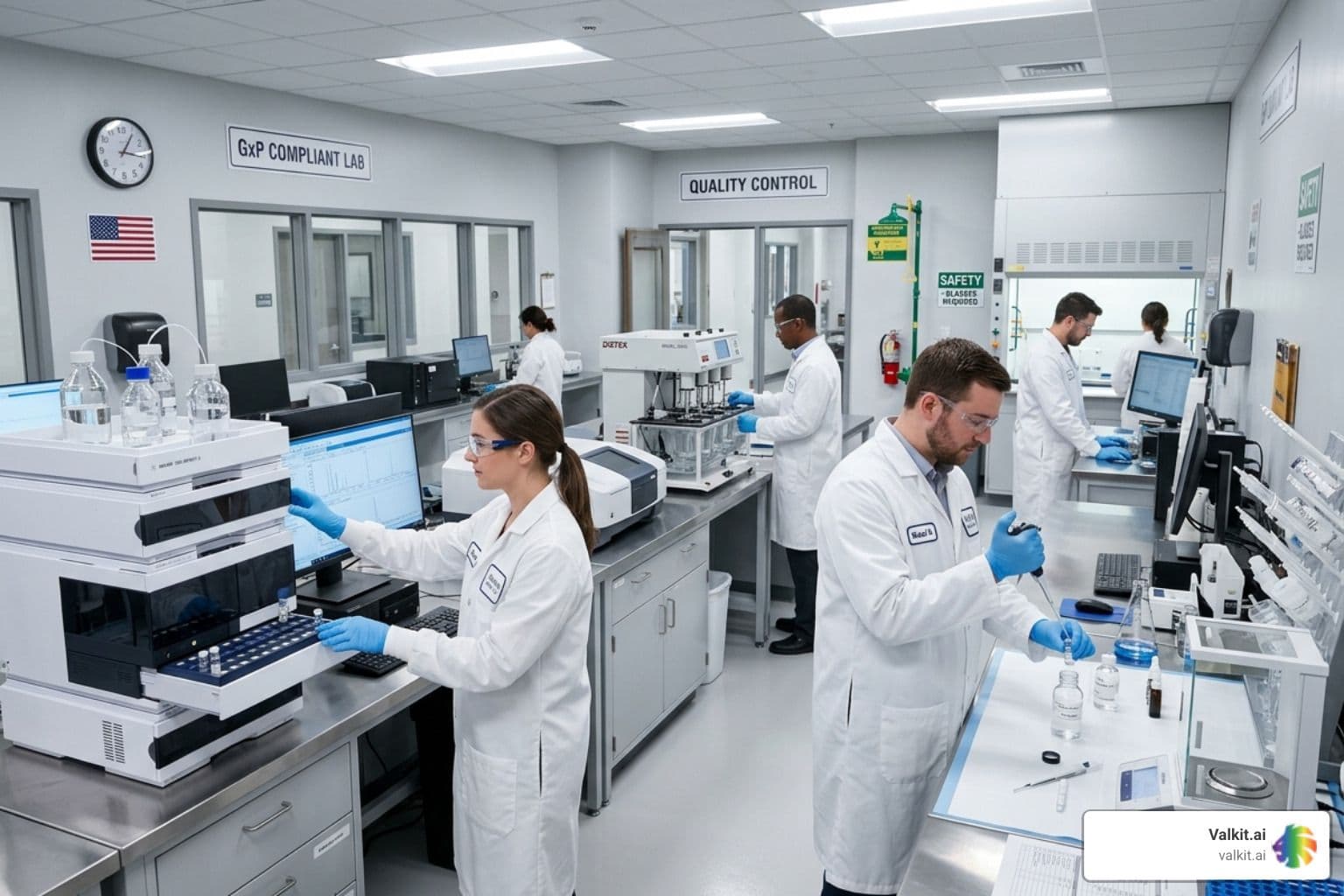
The Essential Guide to GxP Compliance and Software Validation | Valkit.ai
The Essential Guide to GxP Compliance and Software Validation
Master GxP compliance with this essential guide: pillars, ALCOA++, CSV, CSA, audit readiness & ValKit AI solutions.
Steve Ferrell·
What Is GxP Compliance and Why Does It Matter in Life Sciences?
GxP compliance is the set of quality guidelines and regulations that ensure products made for human or animal use — drugs, medical devices, biologics, and food — are safe, effective, and consistently high quality.
The "G" stands for Good, the "P" stands for Practices, and the "x" is a variable that changes depending on the discipline:
Abbreviation Full Name Primary Focus GMP Good Manufacturing Practice Manufacturing quality and process control GCP Good Clinical Practice Ethical conduct of clinical trials GLP Good Laboratory Practice Integrity of non-clinical lab studies GDP Good Distribution Practice Supply chain and storage integrity GVP Good Pharmacovigilance Practice Post-market safety monitoring
No single global body owns GxP. Instead, regulators in each region — the FDA in the US, the EMA in Europe, the MHRA in the UK, and the PMDA in Japan — each publish their own requirements. The underlying goals, however, are consistent everywhere: protect patients, ensure product quality, and make every critical decision traceable.
The stakes are real. Non-compliance can trigger FDA warning letters, product recalls, import bans, or consent decrees — actions that routinely cost companies tens or hundreds of millions of dollars. Data integrity failures alone are among the most common triggers for regulatory action worldwide.
I'm Stephen Ferrell, Chief Product Officer at Valkit.ai, with over two decades of hands-on experience guiding pharmaceutical, biotech, and medical device organizations through GxP compliance and computerized system validation. As chair of GAMP Americas and a contributing author to ISPE GAMP 5 Second Edition, I've spent my career translating complex regulatory expectations around GxP compliance into practical, scalable solutions. In this guide, I'll walk you through everything you need to know — from core principles to modern automation approaches.
Understanding the Core Pillars of GxP Compliance
When we talk about gxP compliance, we are really talking about a massive umbrella that covers the entire lifecycle of a product. Whether a scientist is testing a new compound in a lab in Scotland or a technician is calibrating equipment in Indiana, these rules dictate how work is done, recorded, and verified.
Steve Ferrell
Chief Product Officer
The three most common "pillars" you will encounter are:
Good Manufacturing Practice (GMP): This is the heavy hitter. It ensures that products are consistently produced and controlled according to quality standards. It covers everything from the cleanliness of the facility to the validation of the manufacturing equipment. In the eyes of the FDA, if a process isn't validated, the product is technically "adulterated."
Good Clinical Practice (GCP): This is the ethical heart of the industry. GCP provides a standard for designing, conducting, and reporting clinical trials that involve human subjects. The goal is to ensure the rights, safety, and well-being of trial participants are protected and that the clinical trial data is credible.
Good Laboratory Practice (GLP): This applies to non-clinical health and environmental safety studies. It is all about the integrity of the data generated in the lab. If you are doing a toxicology study to see if a drug is safe for human trials, GLP ensures your results are repeatable and honest.
Beyond these, you will find Good Distribution Practice (GDP), which ensures that medicines are stored and transported under the right conditions (like maintaining the "cold chain" for vaccines), and Good Pharmacovigilance Practice (GVP) for monitoring safety after a drug hits the market.
Regulatory Harmonization and PIC/S
To make life easier for global companies, many regulators work together through the Pharmaceutical Inspection Co-operation Scheme (PIC/S). This organization helps harmonize inspection procedures worldwide, so a GMP audit in the UK looks very similar to one in the US. These standards overlap significantly, providing a comprehensive framework for quality and safety across the industry.
Focus Area GMP (Manufacturing) GCP (Clinical) GLP (Laboratory) Primary Goal Product Quality & Consistency Patient Safety & Data Ethics Data Integrity & Repeatability Key Regulation 21 CFR Part 210/211 ICH E6 (R2) 21 CFR Part 58 Main Activity Large-scale Production Human Trials Safety/Tox Testing
The 5 P’s and Data Integrity: ALCOA++ Principles
At Valkit.ai, we often tell our partners that gxP compliance isn't just a list of rules; it’s a culture. A great way to visualize this is through the 5 P's framework. If you can master these five areas, you are 90% of the way to a clean audit.
People: Personnel must be qualified, trained, and clear on their roles. Training is actually one of the most frequently cited observations in FDA warning letters. It's not enough to do the work; you must prove the person doing it was trained to do it correctly.
Procedures: These are your Standard Operating Procedures (SOPs). They must be documented, followed, and kept up to date. If it isn't in the SOP, it didn't happen.
Products: This refers to the raw materials, components, and the final product itself. There must be strict specifications and testing at every stage.
Premises: The physical environment—whether a lab or a factory—must be clean, controlled, and designed to prevent cross-contamination.
Processes: All critical steps in the manufacturing or testing process must be defined and validated to ensure they consistently produce the desired result.
Legible: Can you read and understand the data for the lifetime of the record?
Contemporaneous: Was it recorded at the time the work was done?
Original: Is it the first recording or a certified true copy?
Accurate: Is it free from errors and reflective of the truth?
The "++" adds Complete, Consistent, Enduring, and Available. In a modern digital world, this means having robust audit trails and electronic signatures that can't be tampered with.
Maintaining Data Integrity for GxP Compliance
In the US, 21 CFR Part 11 is the law of the land for electronic records. In Europe, it’s EudraLex Annex 11. These regulations require us to have system validations, access controls, and audit trails.
We’ve moved far beyond the days of "paper-on-glass" (simply scanning a paper form). True digital validation involves Digital Validation Beyond Paper-on-Glass techniques where metadata is captured automatically, and risk-based data controls ensure that the most critical information is the most protected.
Computer System Validation (CSV) and Modern Technology
If you are using a computer to manage gxP compliance data—whether it’s a lab instrument or a massive cloud database—that system must be validated. Computer System Validation (CSV) is the documented process of ensuring that a software system does exactly what it is designed to do, consistently and reliably.
The gold standard for CSV is the GAMP 5 (Good Automated Manufacturing Practice) guide. It suggests a risk-based approach, focusing your testing efforts on the parts of the software that pose the highest risk to patient safety or product quality.
The traditional model for this is the V-Model:
Requirements: What does the system need to do?
Specifications: How will it be built?
Testing (IQ/OQ/PQ):
Installation Qualification (IQ): Is it installed correctly?
Operational Qualification (OQ): Does it work as intended in a test environment?
Performance Qualification (PQ): Does it work correctly in your specific real-world process?
From CSV to CSA
The industry is currently shifting from CSV toward Computer Software Assurance (CSA). While CSV often involves mountains of "screenshot-heavy" documentation, CSA focuses on critical thinking and unscripted testing. At Valkit.ai, we are Delivering CSA with ValKit AI by automating the tedious parts of the process, allowing quality teams to focus on actual risks rather than paperwork.
Cloud Computing in GxP
Can you use AWS, Azure, or Google Cloud for GxP workloads? Yes. But there is a catch: the Shared Responsibility Model.
The Provider (AWS/Azure): Responsible for the physical security of the data centers and the "cloud" infrastructure.
The Customer (You): Responsible for validating the specific applications you run on that cloud and ensuring they meet gxP compliance standards.
Interestingly, moving to the cloud can actually speed things up. Statistics show a 30-40% reduction in qualification times for moving regulated workloads to the AWS Cloud because you can automate the creation of IQ/OQ reports using standardized templates.
The Role of CSV in GxP Compliance
Validation isn't a one-time event; it’s a lifecycle. Every time you update your software or change a configuration, you must go through Change Control. This ensures that the "validated state" of the system isn't compromised. By Digitizing CQ with ValKit AI, companies can handle these changes in hours instead of weeks, keeping the system compliant without slowing down innovation.
ValKit AI Revolutionizing Validation Execution is a great example of how modern tools use AI to clone existing validation protocols, reducing the manual effort of writing test scripts by up to 80%.
Best Practices for Achieving and Maintaining Audit Readiness
The best time to prepare for an audit was six months ago. The second best time is today. Being "inspection ready" means that if an FDA inspector walks through your door in Indiana or Scotland tomorrow morning, you aren't worried.
1. Conduct Regular Internal Audits
Don't wait for the regulator. Perform "mock inspections" to find your own gaps. This helps you see your processes through the eyes of an inspector before the official visit.
2. Master the CAPA Process
When something goes wrong (a deviation), you need a Corrective and Preventive Action (CAPA) plan.
Corrective: Fix the immediate problem.
Preventive: Change the process so it never happens again. Inspectors love to see a robust CAPA system because it shows you are committed to continuous improvement.
3. Modernize Your Training Management
As we mentioned, training gaps are a magnet for audit findings. You need a system that automatically triggers retraining when an SOP is updated. If you are still using manual spreadsheets to track training, you are sitting on a compliance landmine.
4. Ditch the Legacy Tools
Many companies are still using "paper-on-glass" digital tools that are essentially just glorified PDFs. These systems have high hidden costs—manual data entry, slow approval cycles, and difficult searchability during audits. Understanding The Hidden Costs of Legacy Digital Validation Tools can help you build a business case for moving to an AI-powered platform.
The Consequences of Non-Compliance
It is worth repeating: the cost of failure is astronomical. Beyond the tens of millions in fines, a Consent Decree can effectively shut down your operations until a third party certifies you are compliant. This leads to lost market share and devastating reputational damage. In the life sciences, trust is everything.
Frequently Asked Questions about GxP
What does the 'x' in GxP stand for?
The 'x' is a placeholder for the specific field of practice. For example, in GMP, the 'x' is 'Manufacturing'. In GCP, it is 'Clinical'. It allows the industry to use a single term to describe the overarching philosophy of "Good Practice" while acknowledging that the specific rules for a lab are different from the rules for a factory.
Is cloud storage GxP compliant?
Cloud storage providers like AWS, Microsoft Azure, and Google Cloud are not "GxP certified" because no such official certification exists for infrastructure. However, they provide the tools and security controls (ISO 27001, SOC 2) that allow you to build a GxP-compliant system. You are still responsible for validating the software you put on that cloud.
What are the consequences of GxP non-compliance?
The consequences range from "slap on the wrist" observations (FDA Form 483) to severe legal actions. These include:
Warning Letters: Public notices of violations.
Import Bans: Preventing your products from entering a country.
Product Recalls: Costly and brand-damaging removal of products from shelves.
Consent Decrees: Legal agreements that put your company under intense regulatory supervision.
Conclusion
At its core, gxP compliance is about more than just satisfying a regulator. It’s about operational excellence. When your processes are validated, your data is integral, and your people are trained, you produce better products. You get to market faster because you aren't bogged down by rework or failed batches.
At Valkit.ai, we believe that compliance shouldn't be a bottleneck. By leveraging AI-powered digital validation, we help life sciences companies reduce validation costs by up to 80% and turn validation timelines from weeks into mere hours. Whether you are a startup in Scotland or an established manufacturer in Indiana, the future of compliance is automated, intelligent, and paperless.
Ready to see how smart automation can transform your quality department? Check out our ValKit AI Pricing or book a demo to see the platform in action. Let's make "audit stress" a thing of the past.