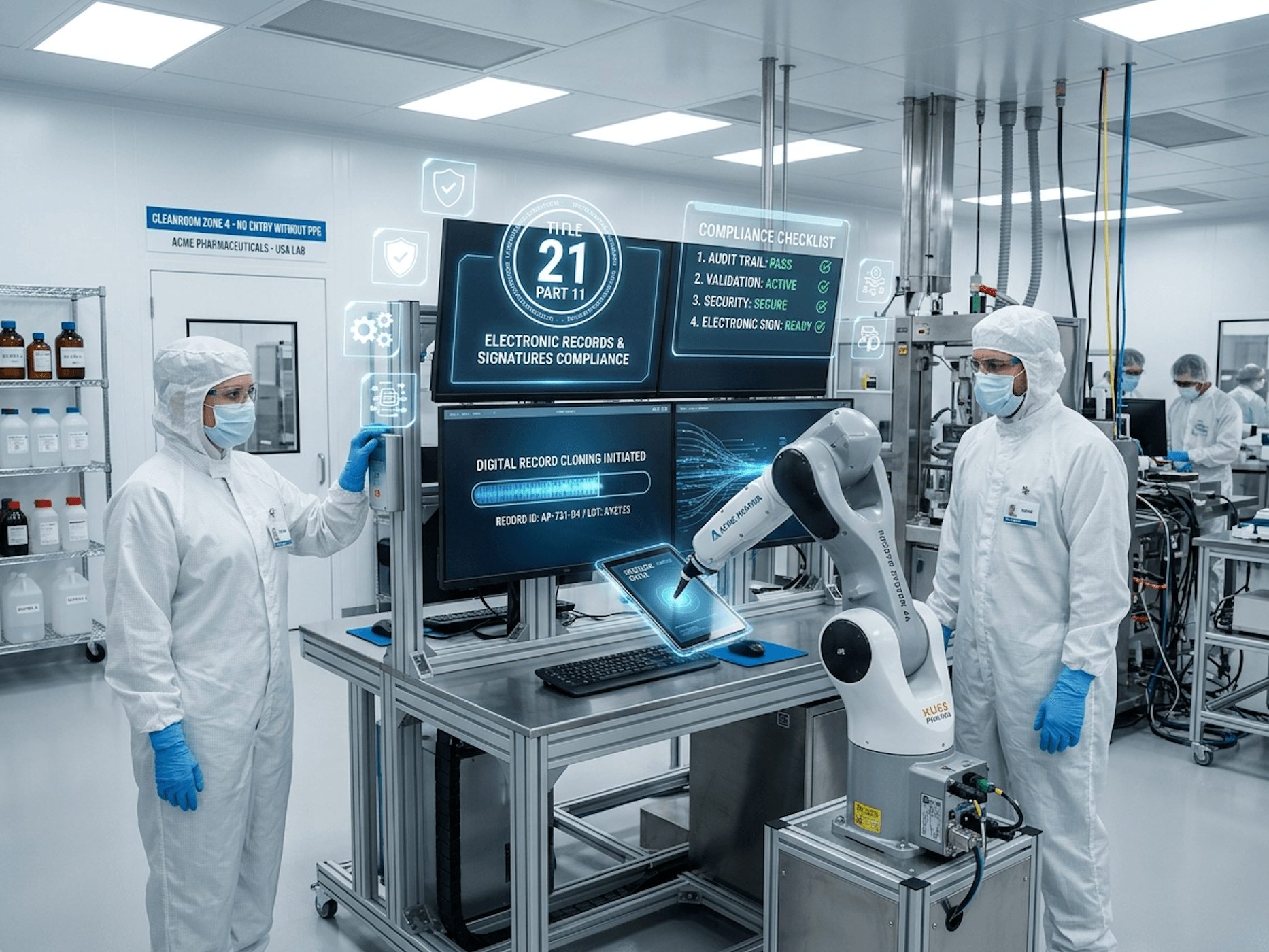
Discover which vendors provide automated cloning and compliance tools specifically for title 21 part 11 validation processes. Explore top LIMS, ELN & AI platforms now!
Steve Ferrell·
What is 21 CFR Part 11 and why is it crucial for automated cloning and validation?
At the heart of regulated life sciences, 21 CFR Part 11 stands as a cornerstone for ensuring data integrity. This regulation, issued by the U.S. Food and Drug Administration (FDA), establishes the criteria under which electronic records and electronic signatures are considered trustworthy, reliable, and equivalent to paper records and handwritten signatures. Its scope is broad, impacting all FDA-regulated industries, including pharmaceuticals, medical devices, and biotechnology.
For labs engaging in automated cloning, understanding and complying with 21 CFR Part 11 is not merely a formality; it's a critical operational imperative. Our work, whether it involves designing intricate plasmids, assembling complex genetic sequences, or analyzing high-throughput experimental data, generates vast amounts of electronic information. Part 11 ensures that every step, from initial design to final validation, is meticulously documented, secure, and verifiable. This means implementing robust controls for data integrity, maintaining comprehensive audit trails that record every action, utilizing secure electronic signatures, ensuring proper record retention, and safeguarding system security through rigorous validation processes.
Why is this so crucial for automated cloning? Imagine a scenario where a critical genetic sequence for a new therapeutic is designed and assembled using automated tools. Without Part 11 compliance, there's no legally defensible assurance that the sequence hasn't been altered, that the design was approved by the correct personnel, or that the experimental data validating its function is accurate and untampered. The reliability and trustworthiness of genetic sequences, plasmid designs, experimental data, and high-throughput results directly impact patient safety and product efficacy.
The consequences of non-compliance are severe. They can range from FDA warning letters and substantial fines to product recalls, manufacturing shutdowns, and significant reputational damage. Therefore, integrating Part 11 compliance into automated cloning workflows from the outset is essential for any regulated lab.
Which vendors offer automated cloning tools with built-in 21 CFR Part 11 compliance features?
The landscape of automated cloning and compliance tools is diverse, with vendors specializing in different aspects of laboratory informatics. Generally, we see solutions falling into categories such as Laboratory Information Management Systems (LIMS) and Electronic Lab Notebooks (ELN), specialized cloning software, and instrument-specific software.
When evaluating any of these tools for Part 11 compliance, we look for several key features:
Robust Audit Trails: Detailed, time-stamped records of all actions, changes, and deletions, ensuring complete traceability.
Secure Electronic Signatures: Mechanisms that link signatures to specific records, verifying identity and intent, and preventing falsification.
Role-Based Access Controls: Granular permissions that restrict access and functionality based on user roles, protecting data integrity.
Data Integrity Checks: Features that ensure data accuracy, completeness, and consistency throughout its lifecycle.
Support for Installation Qualification (IQ) and Operational Qualification (OQ): Documentation and tools to verify that software is installed correctly and performs as intended.
Let's explore some leading vendor categories and representative platforms across these areas.
Leading LIMS/ELN Platforms for Cloning and Compliance
These platforms often serve as the central hub for laboratory data, making their Part 11 compliance features critical for automated cloning workflows.
Benchling: A widely used R&D cloud platform that combines molecular biology workflows with ELN/LIMS capabilities. In regulated settings, organizations often evaluate its auditability, electronic signature support, and broader GxP readiness for cloning-related work.
Sapio Sciences: A configurable LIMS/ELN provider often considered by labs seeking adaptable workflows and support for regulated environments.
LabWare: An enterprise LIMS platform frequently used in large-scale laboratory operations where instrument integration and controlled data handling are important.
Thermo Fisher (SampleManager LIMS): A scalable LIMS option commonly assessed by regulated laboratories managing complex workflows and multiple data sources.
IDBS: Provides ELN and scientific data management capabilities often used in R&D environments with compliance and traceability requirements.
Other notable LIMS/ELN providers that organizations may review include LabVantage, STARLIMS, LabGuru, Scispot, and QBench. Each can play a role in centralizing and managing data from automated cloning processes in a controlled manner, depending on configuration, validation scope, and intended use.
Specialized Cloning and Sequence Analysis Software
While LIMS/ELN platforms provide the overarching data management framework, specialized software is often used for the intricate details of cloning. These tools focus on specific tasks like plasmid design, sequence assembly, primer design, and high-throughput cloning simulation.
For these specialized tools to contribute to a Part 11 compliant workflow, they must either have built-in compliance features or, more commonly, integrate seamlessly with broader LIMS/ELN systems. The importance of robust data transfer protocols and API integrations cannot be overstated. This ensures that the data generated within the specialized cloning software (for example, the final sequence, the plasmid map, or the results of an assembly reaction) is accurately and securely transferred to the compliant LIMS/ELN, where it can be subjected to audit trails, electronic signatures, and long-term retention. This end-to-end traceability is crucial for maintaining compliance across the entire automated cloning workflow.
Instrument-Specific Software with Compliance Capabilities
Many automated cloning workflows rely on sophisticated instruments, and the software controlling these instruments often needs to be Part 11 compliant.
FCS Express (De Novo Software): For flow cytometry, which is often integral to analyzing cell populations after cloning, this platform is frequently evaluated for regulated workflows that require audit trails, electronic signatures, and validation support.
Chromatography Data Systems (CDS): In chromatography, which may be used to purify or analyze components of a cloning reaction, labs typically look for secure audit trails, electronic signatures, and qualification support to maintain data integrity in regulated analytical processes.
Microplate reader and analytical software platforms: These systems are often used alongside plate readers and related instruments that generate data critical to cloning validation, and are typically assessed for auditability, signature controls, and validation service availability.
Because vendor capabilities, deployment models, and validation packages evolve over time, regulated labs should always confirm current Part 11 functionality directly with the supplier during qualification and vendor assessment.
How do digital validation platforms streamline 21 CFR Part 11 compliance for cloning workflows?
While LIMS, ELN, and instrument software provide the operational environment for automated cloning, the validation of these systems themselves is a separate, complex, and critical undertaking. This is where Digital Validation Platforms (DVPs) become indispensable. DVPs play an essential role in Computer System Validation (CSV) for any system handling automated cloning data, ensuring that these systems are fit for their intended purpose and operate in a compliant manner.
DVPs automate the entire validation lifecycle, transforming what used to be a paper-intensive, time-consuming process into an efficient, digital workflow. This includes:
Requirements Management: Centralizing and managing user and functional requirements.
Test Script Generation and Execution: Automating the creation and execution of test scripts, often with digital evidence capture.
Deviation Management: Streamlining the process of documenting, investigating, and resolving deviations.
Traceability Matrices: Automatically linking requirements to design, testing, and risk assessments, providing a clear audit trail.
The benefits of utilizing DVPs are profound: they lead to a significant reduction in validation cycle times and costs, enhance audit readiness by providing real-time access to validated documentation, improve data integrity by automating control points, and simplify overall compliance management.
Key Digital Validation Platform Vendors
Several vendors offer digital validation platforms that can assist in validating systems used for automated cloning.
Kneat Gx: A recognized digital validation platform used across life sciences for managing validation documentation and execution in GxP environments.
ValGenesis (iVal): A digital validation platform designed to automate authoring, execution, and traceability across the validation lifecycle, with support for regulated use cases.
Valkit.ai: Valkit.ai is an AI-powered digital validation platform specifically designed to revolutionize validation execution. We provide up to an 80% cost reduction in validation through AI-powered automation, shrinking validation timelines from weeks to hours. Our platform leverages smart cloning of validation logic, allowing us to rapidly adapt validation processes for similar systems or equipment. We are focused on delivering Computer Software Assurance (CSA), emphasizing critical thinking and risk-based testing while digitizing Commissioning and Qualification (CQ) processes. This makes Valkit.ai a strong solution for validating complex automated cloning systems and supporting rigorous Part 11 requirements with greater efficiency.
Other compliance automation platforms: There are additional platforms that offer tools for electronic records, audit trails, workflow enforcement, and validation support, including QT9 QMS, Process.st, Compliance Associates Validator, and CIMCON Software.
The Impact of Digital Validation on Efficiency and Compliance
The statistics speak for themselves. Modern Digital Validation Platforms are not just an incremental improvement; they represent a major operational shift. They can reduce validation cycle times by over 50% and cut validation costs significantly when implemented effectively.
These efficiencies are especially important for maintaining competitiveness and accelerating development timelines when dealing with the high volume and complexity of automated cloning data. For organizations seeking to modernize validation while supporting 21 CFR Part 11 expectations, a well-implemented digital validation strategy can materially improve both compliance readiness and execution speed.
What are the key considerations for selecting compliant automated cloning and validation tools?
Choosing the right tools for automated cloning and validation requires a comprehensive evaluation. It's not just about finding a tool that "does" cloning or "is" compliant; it's about finding the right fit for your organization's specific needs, scale, and regulatory environment.
Compliance and Validation Support
This is non-negotiable. The chosen tools must offer robust 21 CFR Part 11 features, including:
Comprehensive and secure audit trails that are easy to access and review.
Reliable electronic signatures that meet all Part 11 requirements for authenticity and integrity.
Strong data integrity controls to prevent unauthorized changes and ensure accuracy.
Granular access controls and role-based permissions.
Support for Installation Qualification (IQ) and Operational Qualification (OQ), ideally with vendor-provided validation packages or services.
Consideration for pre-validated software offerings that can significantly reduce your internal validation burden.
Alignment with Computer Software Assurance (CSA) principles, which emphasize critical thinking and risk-based testing over extensive documentation.
Functionality and Scalability
Beyond compliance, the tools must meet your scientific and operational needs:
Specific automated cloning capabilities: Does the software support your particular workflows, whether it's plasmid design, sequence assembly, primer design, or high-throughput screening?
Support for both Research Use Only (RUO) and GxP/clinical environments: Can the system scale with your research, from early-stage discovery to regulated clinical development?
Scalability for growing operations and multi-site deployments: Can the system handle increasing data volumes, more users, and potentially multiple laboratory locations, such as distributed teams across sites?
Deployment, Pricing, and Integration
Practical aspects of implementation and ongoing use are critical for long-term success:
Deployment options: Evaluate cloud (SaaS) versus on-premise solutions. Cloud-native solutions often offer greater accessibility, scalability, and reduced IT overhead, which can be particularly beneficial for distributed teams.
Pricing models: Understand the total cost of ownership (TCO), including subscription fees, per-user costs, module-based pricing, and any hidden costs for support or upgrades.
Integration capabilities: The ability to seamlessly integrate with your existing LIMS, ELN, Quality Management Systems (QMS), Enterprise Resource Planning (ERP) systems, and laboratory instruments is paramount for data flow and traceability.
Vendor Reputation and Support
A vendor is a partner in your compliance journey, so their reliability and support are crucial:
Look at customer satisfaction scores and implementation track records where available.
Seek out user reviews and case studies that demonstrate real-world effectiveness in Part 11 validated cloning workflows.
Ensure the vendor offers responsive technical support and clear pathways for issue resolution.
For validation-focused platforms, vendor expertise in FDA and broader GxP regulated environments is a significant asset.
What emerging trends are shaping the future of compliant automated cloning?
The intersection of automated cloning and 21 CFR Part 11 compliance is a dynamic field, continually shaped by technological advancements and evolving regulatory expectations. Several key trends are emerging that will define the future of compliant automated cloning:
AI and Machine Learning Integration: Artificial intelligence is rapidly moving beyond data analysis to actively shape workflows. We're seeing AI-driven design optimization for cloning, predictive analytics for experimental outcomes, and sophisticated anomaly detection in cloning data. Crucially, AI is also powering validation logic itself. Platforms like Valkit.ai leverage AI for "smart cloning" of validation processes, where AI learns from existing validation data to generate new test scripts and protocols, drastically reducing manual effort and improving consistency. This AI-powered approach is essential for handling the complexity of modern cloning workflows.
Digital Validation as a Service (dVaaS): The concept of dVaaS is gaining traction, offering comprehensive solutions that bundle validation platforms, expert consultancy, and execution services. This model allows organizations to offload the complexities of validation to specialized providers, ensuring compliance without building extensive in-house expertise.
Shift to Computer Software Assurance (CSA): The FDA's evolving stance on CSA emphasizes critical thinking and risk-based testing over extensive, often redundant, documentation. This shift encourages a more efficient, fit-for-purpose validation approach, focusing on ensuring software quality and patient safety rather than merely generating vast quantities of paperwork. DVPs like ours are built to facilitate this agile, risk-based approach.
Convergence of Platforms: The traditional silos between LIMS, ELN, QMS, and validation systems are breaking down. Future solutions will offer increasingly integrated platforms, providing a unified view of data, quality, and compliance across the entire product lifecycle, from initial cloning to manufacturing.
FAIR Data Principles: Ensuring that data is Findable, Accessible, Interoperable, and Reusable (FAIR) is becoming a guiding principle. For compliant automated cloning, FAIR data practices enhance not only scientific discovery but also auditability and regulatory compliance, making it easier to trace, understand, and reuse data for future validations or inspections.
Frequently Asked Questions about 21 CFR Part 11 and Automated Cloning
What is the difference between RUO and GxP environments in terms of Part 11 compliance?
RUO (Research Use Only) environments typically have less stringent regulatory requirements, primarily focusing on scientific rigor and reproducibility. While good data management practices are always recommended, the data generated in RUO settings is not intended for direct use in regulatory submissions for products that impact patient safety or public health. In contrast, GxP (Good Practice) environments—which include GLP (Good Laboratory Practice), GMP (Good Manufacturing Practice), and GCP (Good Clinical Practice)—require strict adherence to 21 CFR Part 11. This is because data generated in GxP environments directly impacts product quality, safety, and efficacy, and will be submitted to regulatory bodies like the FDA. Therefore, robust data integrity, comprehensive audit trails, and secure electronic signatures are mandatory in GxP settings.
Can a lab achieve 21 CFR Part 11 compliance with a mix of different vendor tools?
Yes, it is possible for a lab to achieve 21 CFR Part 11 compliance using a combination of different vendor tools, but it requires careful planning and robust integration. Each individual system within the ecosystem must be designed and configured to comply with Part 11 requirements (e.g., electronic signatures, audit trails). Crucially, the interfaces and data transfer mechanisms between these disparate systems must also ensure data integrity and traceability. This often necessitates a comprehensive Computer System Validation (CSV) strategy for the entire integrated ecosystem. Digital validation platforms are invaluable in this scenario, as they can help manage the validation of multiple systems and their interfaces, ensuring end-to-end compliance.
How does AI specifically help in validating automated cloning processes?
AI can significantly enhance the validation of automated cloning processes by introducing unprecedented levels of efficiency and accuracy. Specifically, AI can:
Automate Test Script Generation: AI algorithms can analyze system requirements and existing validation documentation to automatically generate detailed test scripts, dramatically reducing the manual effort involved.
Intelligent Risk Assessments: AI can identify potential risks and vulnerabilities in automated cloning systems more effectively by analyzing historical data and predicting failure points, allowing validation efforts to be focused where they are most needed.
"Cloning" Validation Logic: Platforms like Valkit.ai use AI to "clone" validation logic. This means that once a validation process is established and executed for one automated cloning system or instrument, AI can learn from it and apply similar validation logic to other, similar systems with necessary adjustments, saving immense time and resources.
Continuous Compliance Monitoring: AI can continuously monitor system performance and data integrity, flagging anomalies or potential compliance deviations in real-time, moving validation from a periodic event to an ongoing process.
By leveraging AI, we can reduce validation cycle times and costs, identify critical test cases, predict potential issues, and ensure continuous compliance, transforming validation from a bottleneck into a competitive advantage for labs engaged in automated cloning.
Conclusion
The intersection of automated cloning and 21 CFR Part 11 compliance is a complex yet critical area for life sciences organizations. As we've explored, a diverse ecosystem of vendors offers tools ranging from comprehensive LIMS/ELN platforms and specialized cloning software to instrument-specific solutions, all designed with compliance in mind. However, the true game-changer in managing this complexity lies in Digital Validation Platforms.
These platforms streamline the entire validation lifecycle, driving significant reductions in cycle times and costs while enhancing audit readiness and data integrity. By embracing solutions that combine advanced cloning capabilities with comprehensive compliance features and AI-powered validation, labs can navigate regulatory landscapes with confidence and efficiency. For organizations seeking to revolutionize their validation processes and achieve unparalleled compliance, we invite you to explore how Valkit.ai's AI-powered digital validation platform can transform your operations.