Demystifying GRC Technology Platforms for Modern Businesses | Valkit.ai
Demystifying GRC Technology Platforms for Modern Businesses
Explore how a modern GRC software platform drives governance, risk mitigation, and compliance automation for enterprises in 2026.
Steve Ferrell·
Why Choosing the Right GRC Software Platform Can Make or Break Your Compliance Program
A GRC software platform is a centralized tool that unifies governance, risk management, and compliance activities into a single system — replacing scattered spreadsheets, siloed tools, and manual processes.
Quick answer: What are the leading GRC software platforms in 2026?
Platform Best For MetricStream Large enterprises, regulated industries ServiceNow GRC Organizations already on ServiceNow AuditBoard Audit-led GRC programs Riskonnect Comprehensive, integrated enterprise GRC Workiva GRC unified with financial and ESG reporting Onspring Highly configurable, low-code GRC automation Risk Cognizance AI-powered, cybersecurity-focused GRC LogicGate Mid-market, flexible risk workflows
Every compliance team is under pressure to do more with less. Regulatory frameworks keep multiplying. Audit cycles are getting shorter. And the cost of getting it wrong — in fines, delays, or reputational damage — keeps climbing.
Yet most teams are still stitching together answers from disconnected tools, email threads, and aging spreadsheets.
That gap between what organizations need and what their current tools deliver is exactly why GRC platforms have become a strategic priority — not just an IT purchase. According to a Forrester Total Economic Impact study, organizations using integrated GRC platforms report a 133% ROI and $8.4 million in total benefits. That's not a marginal improvement. That's a structural change in how compliance gets done.
For validation managers in pharma, biotech, and medical devices, the stakes are even higher. Regulatory complexity across frameworks like HIPAA, GDPR, ISO 27001, NIST, and 21 CFR Part 11 means that choosing the wrong platform — or no platform at all — directly translates into longer timelines, higher costs, and audit risk.
I'm Stephen Ferrell, Chief Product Officer at Valkit.ai, and over more than two decades in IT governance, software assurance, and GxP compliance, I've helped hundreds of regulated organizations evaluate and implement GRC software platforms that actually reduce risk rather than just document it. In this guide, I'll walk you through what to look for, how the leading platforms compare, and how to make a decision that fits your organization's real-world needs.
Steve Ferrell
Chief Product Officer
What is a GRC Software Platform and Why Does It Matter in 2026?
At its core, a grc software platform is designed to support a holistic enterprise risk management (ERM) process. It serves as a "digital twin" of your organization, mapping out how your assets, business processes, risks, and controls connect to external regulatory requirements.
Historically, companies treated governance, risk, and compliance as three distinct silos:
Governance: The executive team setting policies and strategic direction.
Risk: Operational leaders identifying obstacles and security vulnerabilities.
Compliance: Legal and audit teams checking boxes to satisfy external regulators.
Operating this way in 2026 is a recipe for disaster. With the explosion of complex, overlapping regulations—such as NIS2, DORA, the EU AI Act, GDPR, and continuous updates to FDA guidelines—relying on manual processes is no longer viable. Manual compliance is slow, prone to human error, and completely blind to real-time risks.
A modern grc software platform bridges these silos by turning static compliance requirements into dynamic, automated workflows. Rather than treating compliance as a reactive "annual exam," an automated compliance platform enables continuous monitoring. This keeps organizations audit-ready 24/7 and transforms compliance from a operational bottleneck into a competitive advantage.
According to the celebrated Forrester GRC ROI study, the financial impact of making this transition is clear: organizations achieved millions in total benefits by eliminating redundant testing, reducing audit fees, and avoiding costly compliance failures.
Core Capabilities of a Modern GRC Software Platform
To move past what some in the industry call "prettier Excel," a modern GRC platform must do heavy lifting behind the scenes. It needs to serve as a single source of truth that connects every department.
The foundational capabilities of an enterprise-grade GRC platform include:
Centralized Risk Registers: A dynamic repository where risks are identified, categorized, and scored. Rather than simple 5x5 heatmaps, advanced tools now translate risk into annualized monetary exposure, helping the board make data-driven investment decisions.
Policy Management: A lifecycle tool to draft, review, approve, and distribute corporate policies. This ensures that every employee has read and signed off on the latest guidelines, with a complete audit trail to prove it.
Internal Audit Management: Tools that streamline the planning, execution, and reporting of internal audits. Auditors can easily map findings back to specific controls and track remediation efforts in real time.
Continuous Monitoring: Integrations with your IT infrastructure, cloud environments, and HR systems to pull evidence automatically, flagging control failures the moment they happen.
For highly regulated sectors, these capabilities must align with strict GxP compliance standards, ensuring that data integrity, electronic signatures, and system validations meet global regulatory demands.
Key Features of an Enterprise GRC Software Platform
When comparing platforms, look closely at how they handle day-to-day operations. The best enterprise systems share several key features:
Intelligent Framework Mapping: If you comply with ISO 27001, SOC 2, and NIST, you shouldn't test the same password control three times. Modern platforms use a unified control framework to map a single control to multiple standards, reducing duplicate compliance work by up to 60%.
Automated Evidence Collection: Instead of compliance managers chasing engineers for screenshots, the platform connects directly to systems like AWS, Jira, or Okta via APIs to pull evidence automatically.
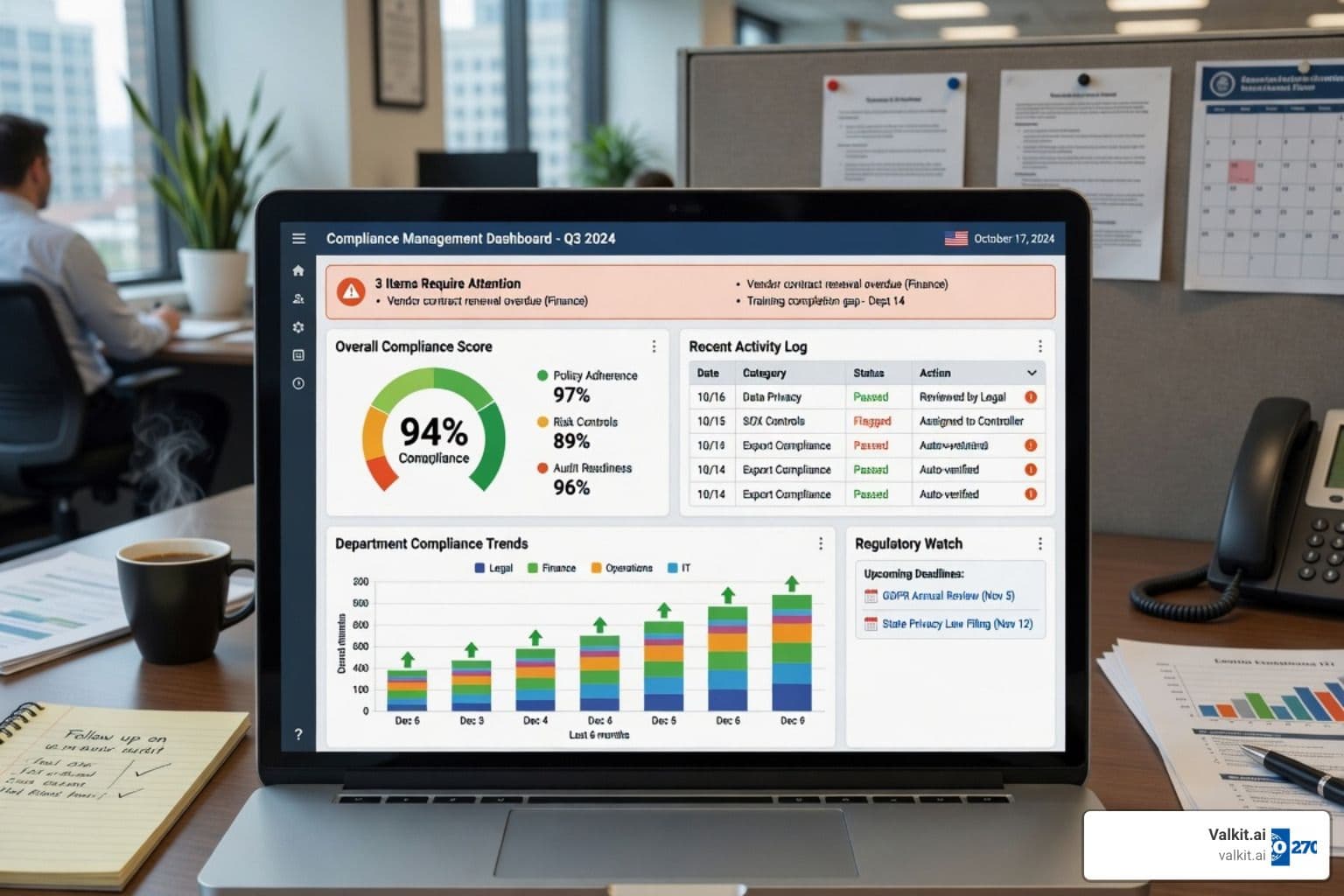
Real-Time Executive Dashboards: Board-ready reports that visualize compliance posture, open risks, and audit progress instantly, removing the need for weeks of manual slide deck preparation.
Open Architecture: Some organizations are even turning to an open-source GRC operating system to build highly customized, modular compliance programs without the steep licensing fees of legacy software.
Managing Cyber Risk, ESG, and Third-Party Vendors
The scope of GRC has expanded far beyond traditional financial and legal checklists. Today, a grc software platform must actively manage specialized, high-stakes areas:
Cybersecurity & IT Risk: Platforms must integrate with vulnerability scanners and attack surface management tools to prioritize threats based on actual business risk.
Third-Party Risk Management (TPRM): Your security is only as strong as your weakest vendor. Leading platforms automate vendor onboarding, send smart risk questionnaires, and continuously monitor external threat intelligence.
ESG Reporting: With sustainability disclosures becoming mandatory globally, modern GRC tools compile environmental, social, and governance data alongside traditional risk metrics.
Regulatory Timelines (e.g., NIS2): New regulations demand rapid responses, such as the 24-hour and 72-hour incident reporting windows under NIS2. This requires tightly integrated incident response and business continuity workflows.
This is where the industry is shifting toward next-generation agentic GRC platform capabilities. Rather than acting as passive databases, agentic GRC platforms use specialized AI agents to actively perform tasks—like reading a third-party SOC 2 report, automatically extracting relevant clauses, and flagging potential compliance gaps without human intervention.
Comparing the Top GRC Software Platforms of 2026
To help you navigate the busy GRC marketplace, we have compiled a detailed comparison of the leading platforms in 2026, focusing on their core strengths, target audience, and unique technological approaches.
How to Evaluate and Select a GRC Software Platform
Selecting the right platform requires looking past marketing promises to assess how a tool fits into your daily operations. Consider these key evaluation criteria:
Integration Depth: Does the platform have pre-built API connectors for your existing tech stack (ERPs, HR software, cloud infrastructure, and security tools)?
Configurability vs. Customization: Can your team adjust workflows, risk scoring models, and fields without writing code? Platforms built on low-code architectures allow you to adapt the system quickly as your business grows.
User Adoption & Interface: If the front-line staff find the tool confusing, they won't use it. Prioritize platforms with clean interfaces and automated reminders to minimize the training burden.
Scalability: Ensure the platform can handle multiple subsidiaries, complex organizational structures, and new international frameworks as you expand.
For example, looking at Onspring GRC platform features, many organizations appreciate its highly adaptable, low-code design. Onspring users report a 70% increase in GRC efficiency and a 40% reduction in coordination time, largely because the platform allows non-technical administrators to build and launch custom compliance programs in under 30 days.
Leading GRC Tools Compared
Let's look at how the top-tier solutions differentiate themselves:
Riskonnect: Widely regarded as a premier enterprise platform, Riskonnect excels at deep risk correlation. By integrating enterprise risk, cyber risk, and third-party risk on a single architecture, it provides unmatched risk visibility for global organizations.
MetricStream: A dominant force for large enterprises in heavily regulated sectors. According to recent MetricStream GRC tools analysis, their "AI-First" approach embeds machine learning directly into daily workflows, automating regulatory alert triage and predicting compliance gaps before they turn into audit failures.
ServiceNow GRC: An exceptional choice if your organization already runs on ServiceNow for IT service management. It turns operational IT data directly into compliance evidence, though it can be overly complex for teams looking for a standalone GRC tool.
AuditBoard: The gold standard for audit-led GRC programs. It features a highly collaborative, user-friendly interface that internal audit and compliance teams love.
United GRC: If your primary goal is rapid framework readiness, United GRC compliance automation is built to simplify compliance at scale. Offering pre-built packages for CMMC, SOC 2, and FedRAMP, its intelligent mapping engine reduces duplicate control testing by 60% and slashes manual compliance workloads by up to 80%.
Hicomply: Ideal for growing businesses and security leads who want to establish a robust compliance program quickly. Hicomply GRC solutions save teams an average of 10 workdays per month through smart automation, offering built-in audit tools that can save thousands in external consultant fees.
Overcoming Implementation Challenges and Maximizing ROI
Implementing an enterprise-wide GRC platform is a major undertaking. Without a clear strategy, projects can easily stall, run over budget, or fail to gain traction with employees.
To ensure a successful rollout, watch out for these common implementation hurdles:
The "Garbage In, Garbage Out" Trap: Importing messy, outdated spreadsheet data into a brand-new GRC tool simply automates your existing chaos. Take the time to clean, deduplicate, and standardize your risk registers and control libraries before migration.
Underestimating Change Management: Moving from manual tracking to an automated platform requires a shift in company culture. Involve your front-line control owners early in the selection process and provide role-specific training.
Over-Customization: Legacy GRC implementations often failed because companies tried to force the software to replicate their old, inefficient manual processes. Instead, embrace the pre-configured best practices and workflows built into modern platforms.
For organizations in highly specialized sectors like life sciences, general-purpose GRC platforms sometimes fall short when it comes to the technical nuances of product and software validation.
If you are developing medical tech, our medical device compliance software guide outlines how targeted digital validation tools can bridge the gap between high-level enterprise risk management and engineering-level compliance.
Similarly, managing product quality and regulatory submissions requires specialized pharmaceutical compliance management software to maintain strict compliance with global health authorities without slowing down your manufacturing and development pipelines.
Frequently Asked Questions about GRC Platforms
What is the difference between traditional and AI-powered GRC?
Traditional GRC software functions primarily as a centralized database—essentially a structured repository where compliance teams manually upload documents, update risk scores, and fill out forms.
AI-powered GRC platforms, on the other hand, actively assist with the work. They use predictive insights to flag emerging risks, automatically classify evidence documents using OCR, map controls across different frameworks, and utilize intelligent agents to draft policies or answer security questionnaires. This shifts your compliance program from a reactive, manual effort to a proactive, automated system.
How long does it take to implement a GRC platform?
The implementation timeline varies depending on the size of your organization and the complexity of your processes. A highly configurable, low-code platform can often launch its first program in under 30 days.
For large, multi-national enterprises integrating legacy systems across several departments, a full rollout typically takes between 3 to 9 months. Phasing your implementation—starting with a single framework like ISO 27001 or SOC 2 before scaling up—is the most reliable way to ensure success.
Can GRC software integrate with existing IT systems?
Yes. Modern GRC platforms rely heavily on API connectors to build a single source of truth. They integrate with ERPs (like SAP or Workday) for financial and operational data, cloud providers (like AWS or Azure) for infrastructure monitoring, and security tools (like SIEMs and vulnerability scanners) to track cyber risks in real time.
Conclusion
Choosing the right grc software platform is one of the most impactful decisions a risk or compliance leader can make. By unifying your governance, risk, and compliance activities into a single, automated system, you can eliminate manual silos, dramatically reduce audit preparation time, and give your executive team the clear, real-time insights they need to make confident business decisions.
At Valkit.ai, we understand how challenging it is to maintain absolute compliance in highly regulated environments. Operating from our technology hubs in Scotland and Indiana, we provide an AI-powered digital validation platform designed specifically for the pharmaceutical, biotech, and medical device industries.
While enterprise GRC platforms manage your high-level corporate governance and organizational risk, Valkit.ai handles the complex, technical heavy lifting of GxP validation. Our platform reduces software and system validation costs by up to 80% and slashes project timelines from weeks to hours through intelligent automation, test cloning, and built-in regulatory compliance tools.